Don't miss our holiday offer - up to 50% OFF!

What Your Money Should Really Buy When You Sign Up for IPTV in Britain

Most people buy a UK IPTV subscription the way they buy a phone case: quickly, cheaply, and with a vague hope it’ll hold up. Then a big Saturday evening arrives, the stream freezes, and the support chat goes quiet. I’ve watched that cycle repeat for the best part of fifteen years, and the lesson never really changes.
Here’s the short answer to the question you came with. A good UK IPTV subscription is licensed for what it carries, delivered by an IPTV provider with real infrastructure, backed by people who actually reply, and priced so the business behind it can survive the year. Everything else in this guide is about testing those four things before your money leaves your account.
Over the years I’ve sat on both sides of the table. I’ve tested services as a viewer on a creaky Fire TV Stick in a Midlands flat, and I’ve worked behind the scenes on the panel software an IPTV reseller uses to manage customers. That double view shapes everything below, so expect opinions as well as facts.
What a UK IPTV Subscription Actually Buys You
Strip away the marketing and IPTV is simply television delivered over your internet connection rather than an aerial or a satellite dish. You pay for access to live channels, an on-demand library, an electronic programme guide, and the right to log in on a set number of devices. Broadly, that’s the product.
What you’re really buying, though, is reliability. Any UK IPTV subscription lives or dies on servers, bandwidth, load balancing and the competence of whoever is watching the dashboard at 8pm on a busy night. Two services can advertise identical channel counts and deliver completely different evenings.
Think of it like booking a hotel. The brochure lists the same features as the place next door, yet one has staff on the front desk at midnight and the other has a laminated sign and a phone number nobody answers. You only find out which one you’ve booked after you’ve checked in.
The parts you see and the parts you don’t
On screen, you’ll notice picture quality, how fast channels switch and how tidy the guide looks. Behind the screen sit the things that matter far more: server locations, backup capacity when a node fails, and how the IPTV provider copes with sudden traffic spikes. A cheap service often looks fine in its first week precisely because that hidden layer hasn’t been tested yet.
The Legal Line Worth Taking Seriously
Before any talk of features, a word on legality, because this is where British buyers get caught out most often. IPTV as a technology is perfectly legal. Plenty of household names already deliver television this way, and the plumbing underneath is the same whether a stream is licensed or not.
Unlicensed content is a different matter entirely, and UK law treats it seriously. The Digital Economy Act 2017 raised the maximum prison sentence for online copyright infringement to ten years, and sellers of illegal streams have been jailed in recent years. Viewers carry risks too, because unlicensed apps often skip basic security checks and can expose devices to malware and payment fraud.
So my first rule is blunt. If a UK IPTV subscription promises every premium channel in the country for a few pounds a month, ask yourself how that maths could possibly work with proper licences in place. Usually it can’t.
Spotting an offer that’s too good to be true
That doesn’t mean every smaller brand is suspect. Licensed niche services, international packages and white label platforms run by legitimate businesses all exist and do perfectly well. The warning signs are fairly consistent: phrases like “fully loaded” or “jailbroken”, no company name, no terms of service, and a seller who changes the subject when you ask about licensing.
Learn to spot those signals and you’ll avoid most of the bad offers on the market. Ten minutes of healthy suspicion before you pay will make you a much sharper buyer.
Provider, Reseller or Service: Who Are You Paying?
Ever wondered why the same service seems to pop up under five different brand names? The answer is the reseller model, and understanding it clears up a lot of confusion. It also explains who you should complain to when something breaks.
Three roles usually sit behind a single purchase:
- Infrastructure belongs to the IPTV provider, who owns or rents the servers, handles encoding, manages content agreements and runs the core platform.
- Bulk access is what the IPTV reseller buys, usually as credits on a management panel, before selling subscriptions to end customers under their own brand with their own support.
- Everything you experience as a viewer, from the app and channel list to the guide and the help desk, makes up the IPTV service itself.
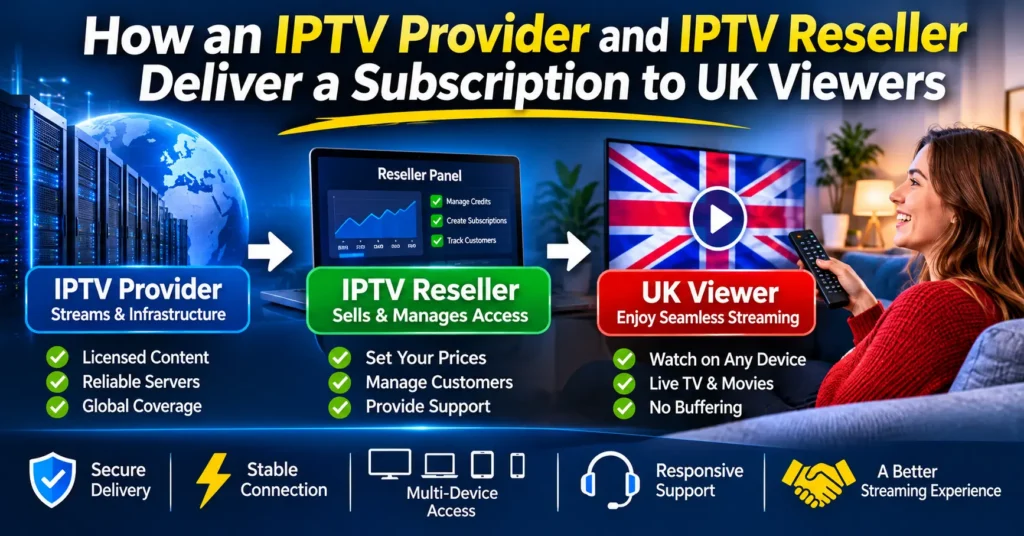
None of this is sinister. Resellers exist in almost every subscription industry, from mobile networks to web hosting, and they sit behind almost every UK IPTV subscription sold online. A good one adds genuine value through local support, setup help and quicker replies than a large wholesaler could ever manage.
Trouble starts when a reseller knows nothing about the platform they’re selling. If your seller can’t tell you who supplies the infrastructure, or goes silent the moment a stream buffers, you’re buying from a middleman with no tools. A capable IPTV reseller, by contrast, can see your account status, reset connections and escalate problems properly.
A quick test you can run today
Message the seller before you buy and ask two plain questions: who handles outages, and how quickly do they usually respond? A professional will answer clearly and without fuss. Vague replies, or answers that only talk about channel numbers, tell you most of what you need to know.
9 Proven Checks Before You Commit to a UK IPTV Subscription
This is the heart of the guide. I’ve refined these checks over years of testing, and they work whether you’re spending £8 or £80. Run through them in order and you’ll weed out most of the poor options before they cost you a penny.
1. A trial that reflects real use
A free or low-cost trial is only useful if you test it properly. Watch between 8pm and 10pm, especially on Friday and Saturday, rather than at 10am on a Tuesday when the servers are idle. Any UK IPTV subscription can look stable when nobody else is using it.
2. Transparent legal standing
Look for a business name, a registered address and readable terms of service. Ask what the service is licensed to carry. Legitimate operators don’t flinch at that question, and the ones who do have answered it for you.
3. Honest uptime claims
Promises of 100 percent uptime are a red flag rather than a selling point. Real infrastructure has maintenance windows and the occasional fault. An honest IPTV provider will admit that and explain how they handle it.
4. Support you can actually reach
Check the support channels before you pay. Email, ticket systems, WhatsApp or live chat all work, provided someone replies within a reasonable window. Send a test question and time the response, because that number tells you more than any advert.
5. Device compatibility
Confirm the service works on what you already own, whether that’s an Amazon Fire TV Stick, an Android TV box, a Samsung or LG smart TV, a MAG box or a phone. Also check how many simultaneous connections are included. Households with teenagers burn through those faster than you’d expect.
6. A working programme guide
An electronic programme guide sounds like a small detail until it’s missing. A UK IPTV subscription without a reliable EPG feels like reading a newspaper with the dates torn off. Ask whether the guide updates automatically and covers the channels you actually watch.
7. Payment methods that protect you
Be wary of sellers who only accept untraceable payments, crypto or gift cards. Under UK consumer credit law, a credit card purchase between £100 and £30,000 makes your card company jointly liable if the seller breaks the contract, which can cover an annual plan. Smaller or debit card payments may still be disputed through your bank’s chargeback process, although that isn’t a guaranteed legal right.
8. Clear renewal and refund terms
Read what happens when your term ends. Does it renew automatically, and can you cancel within a set window? A short, readable policy suggests a business that expects to still be trading next year.
9. Reputation that isn’t manufactured
Reviews on a seller’s own website prove very little. Look for independent mentions on Reddit, Trustpilot or tech forums, and watch how the seller responds to criticism. A calm, helpful reply to a bad review is more reassuring than fifty glowing ones.
Why Price Tells You Less Than You Think
Price is the first thing everyone looks at, and it’s the least informative number on the page. A very cheap UK IPTV subscription and a mid-priced one might share the same channel list, yet one runs on overloaded servers while the other has headroom for busy nights. You simply can’t see that difference on a pricing table.
| Monthly price band | What you typically get | Common risks | Best suited to |
|---|---|---|---|
| Under £5 | Huge channel counts, minimal support | Frequent buffering, unclear licensing, sudden shutdowns | Rarely anyone, honestly |
| £5 to £12 | Reasonable stability, basic support, one or two connections | Patchy peak-time performance | Single viewers testing the waters |
| £12 to £20 | Stronger infrastructure, responsive support, EPG and catch-up | Higher upfront cost on annual plans | Families and regular viewers |
| £20 and above | Licensed premium packages, multiple connections, dedicated help | Paying for extras you might not use | Households wanting zero fuss |
Treat those bands as my own observations from testing rather than published industry data. They shift with server costs, exchange rates and competition. Still, the pattern has held remarkably well year after year.
Resellers fall into the same trap from the other direction. When an IPTV reseller chases the cheapest wholesale credits, they inherit every weakness of that supplier and pass it straight to their customers. I’ve covered this in detail in Why the Lowest Price Is Rarely the Best Deal for Resellers → /why the lowest price is rarely the best deal for resellers, and the same logic applies to anyone buying a single subscription.
Annual plans deserve a mention too. They’re usually cheaper per month, but they lock you in. I’d only commit to twelve months after a successful month-long run with the same IPTV service.
Devices and Apps That Make or Break the Experience
Your hardware matters almost as much as the service itself. I once spent an entire weekend blaming a perfectly decent provider for constant stuttering, only to discover my router was sitting behind a fish tank and a brick wall. Moving it four feet fixed everything, and I felt rather foolish.
Ethernet beats Wi-Fi every time if you can manage it. Where cables aren’t practical, a mesh system such as Google Nest Wifi or TP-Link Deco tends to cope far better than a single ageing router. The best UK IPTV subscription in the world can’t fix a weak signal in the back bedroom.
Apps make a noticeable difference as well. TiviMate is a favourite among enthusiasts for its clean guide and recording features, while IPTV Smarters Pro stays popular because it’s simple and runs on lots of devices. Neither app supplies content on its own; each is just a player for whatever you’ve subscribed to.
Smart TV apps are convenient, yet they’re often the weakest link. Manufacturers update their app stores unpredictably, and some players vanish from them without warning. A dedicated streaming stick or box gives you more control and usually smoother playback.
Broadband speed: how much is enough?
In my testing, a single HD stream runs comfortably on about 10 Mbps, while 4K wants 25 Mbps or more per stream. Live IPTV is less forgiving than on-demand video because it can’t buffer far ahead, so add those figures together for every stream running at once. Most “the IPTV is buffering” complaints I’ve investigated turned out to be weak home Wi-Fi rather than the broadband line or the provider.
Your First Week Checklist
Once you’ve chosen, the first seven days tell you nearly everything. Use this routine while you’re still inside any trial or cancellation window:
- Log in on every device you plan to use and confirm the connection limit
- Watch at least two peak-time evenings, ideally a Friday and a Saturday
- Open the programme guide and check it matches what’s actually airing
- Send one support question and note how long the reply takes
- Try catch-up or on-demand content if it was part of the offer
- Save your login details, renewal date and seller contact somewhere safe
If your UK IPTV subscription passes all six, you’ve probably found a keeper. Fail two or more, and it’s time to cancel during the trial window and move on without guilt.
Where British IPTV Is Heading Next
Change is coming quickly. Traditional pay TV is steadily moving towards internet delivery, with broadcasters nudging audiences from satellite and aerial towards streaming apps. Eventually the line between “normal” television and IPTV will blur until most viewers stop noticing the difference.
Such a shift should favour quality. As more people expect a UK IPTV subscription to behave like any mainstream streaming app, services built on shaky infrastructure will struggle to keep customers. Buffering that people tolerated five years ago simply won’t wash anymore.
Enforcement is tightening as well. Rights holders have increasingly targeted not only sellers but the infrastructure behind unlicensed streams, which makes pirate services even less dependable than before. For honest operators that invest in licensed content and proper servers, the outlook is genuinely bright.
Where does that leave you as a buyer? In a stronger position than ever, provided you ask the right questions. Viewers who treat a UK IPTV subscription like any other considered purchase, rather than an impulse buy, will get far better value.
Final Thoughts From the Editor’s Desk
Fifteen years in this industry have taught me that the right UK IPTV subscription rarely shouts the loudest. It answers your messages, it’s upfront about what it carries, and it keeps working on the nights that matter. Those qualities don’t show up in flashy adverts, but you’ll feel them every single evening.
Take the nine checks, run a proper trial, and don’t let a tempting price talk you out of common sense. Your evenings are worth more than a few saved pounds. Pick carefully, test honestly, and enjoy the telly.
Frequently Asked Questions
Is a UK IPTV subscription legal?
The technology itself is completely legal, and many mainstream broadcasters already use it. What matters is whether the service holds the rights to the content it streams. A UK IPTV subscription offering licensed channels from a registered business is fine, while services selling unlicensed premium content are not. If the price looks impossibly low for what’s included, treat that as a warning sign.
How much should a UK IPTV subscription cost?
Most reliable options fall somewhere between £10 and £20 a month, depending on connections, extras and licensed packages. Anything under £5 usually cuts corners on infrastructure, support or licensing. Annual plans can lower the monthly cost, but only commit after a successful trial. Paying slightly more for stability almost always works out cheaper in frustration.
What’s the difference between an IPTV provider and an IPTV reseller?
An IPTV provider runs the core infrastructure, including servers, encoding and the main platform. An IPTV reseller buys access in bulk, often as panel credits, and sells subscriptions under their own brand. Good resellers add value through local support and faster replies. Weak ones simply pass on problems they can’t fix.
What internet speed do I need for a UK IPTV subscription?
A single HD stream usually runs well on about 10 Mbps, while 4K needs 25 Mbps or more. If several people watch at once, add those figures together for each stream. Stability matters more than headline speed, so a wired connection or mesh Wi-Fi often fixes buffering. Test your speed between 8pm and 10pm to see your real evening performance.
Can I cancel if the IPTV service stops working?
That depends entirely on the seller’s terms, which is why you should read them before paying. Reputable sellers offer a trial or a short refund window and explain renewal rules clearly. Paying by card or through a recognised processor gives you extra protection if a seller disappears. Keep records of your purchase and any support messages, just in case.