Don't miss our holiday offer - up to 50% OFF!

Why IPTV Has Become the World Cup Viewer’s Best Friend

Picture this: it’s the opening match of the World Cup. You’ve got snacks sorted, friends packed onto the sofa, and then your cable signal drops. Or worse, you discover the game is behind a paywall on a broadcaster you’ve never subscribed to. It’s a situation millions of football fans know all too well.
That’s precisely why IPTV World Cup streaming has exploded in popularity over the past two tournament cycles. Internet Protocol Television, or IPTV, delivers live content over a broadband connection rather than satellite or terrestrial signals, and for a global event like the World Cup, the flexibility it offers is genuinely remarkable.
I’ve spent the better part of the last three years testing IPTV setups across different devices and connection speeds, and the honest truth is that the technology has matured considerably. What was once a patchy, unreliable alternative to traditional broadcasting is now, in many cases, a superior experience. Sharp picture quality, multiple language commentary options, and the ability to watch on any screen you choose it’s hard to go back once you’ve had a proper IPTV setup humming along during a tense penalty shootout.
That said, not all IPTV services are equal. And there are real considerations around legality, stability, and setup that most guides gloss over. This one won’t.
What You Actually Need Before Kick-Off
Before you commit to any IPTV World Cup solution, you need to be honest with yourself about your home setup. The technology is only as good as the infrastructure supporting it.
Here’s what to audit before the tournament begins:
- Broadband speed — For HD streams, you’ll want a consistent 10 Mbps minimum. For 4K IPTV World Cup coverage, budget for at least 25 Mbps. Note: this means consistent, not just the headline number your ISP advertises.
- Router placement — If your streaming device is more than two rooms away from your router and you’re relying on Wi-Fi, expect problems. A wired Ethernet connection or a powerline adapter is always preferable for live sport.
- Compatible device — Firestick, Android TV box, Smart TV with an IPTV app, or a laptop all work. However, dedicated IPTV set-top boxes often deliver better results than app-based solutions on budget smart TVs.
- A reliable VPN — This isn’t just about privacy. A VPN like ExpressVPN or NordVPN can help you access geo-restricted IPTV World Cup broadcasts and, crucially, can prevent ISP throttling during peak sports events.
The VPN point is worth dwelling on. Several major UK and European ISPs have been known to throttle streaming traffic during high-demand events there’s documented evidence of this practice, and consumer advocacy groups including Which? have flagged it repeatedly. A decent VPN sidesteps the issue entirely.
Choosing the Right IPTV Service for World Cup Matches
This is where things get genuinely complicated, and I won’t pretend otherwise.
The IPTV market is split between licensed services and unlicensed (often called “grey market”) providers. Licensed IPTV service platforms like Hulu + Live TV in the US, NOW TV in the UK, or DAZN in various markets have the rights to broadcast World Cup matches in their respective territories. They’re stable, legal, and properly supported. The trade-off is cost, and during a World Cup year, the pricing can feel extortionate.
Then there’s the grey market. Hundreds of IPTV resellers subscription packages promising thousands of channels, including every World Cup match, for a fraction of the price of official services. Some of these work surprisingly well during standard viewing periods. But live sport, and specifically IPTV World Cup coverage, is where they frequently crumble.
Here’s a comparison worth keeping in mind when evaluating your options:
| Feature | Licensed IPTV Service | Grey-Market IPTV |
|---|---|---|
| Legal status | Fully licensed | Legally ambiguous |
| Stream stability | High | Variable |
| World Cup coverage | Regional (may need multiple services) | Claims full coverage |
| Customer support | Available | Minimal or none |
| Picture quality | Consistent HD/4K | Inconsistent |
| Monthly cost | £10–£50 | £5–£15 |
As TechRadar noted in their IPTV coverage last year, grey-market services tend to struggle most precisely when demand spikes during big games, at half-time when everyone’s refreshing, and during finals week. That’s when you’ll feel the absence of proper infrastructure most acutely.
My honest editorial take? For the World Cup specifically, using a licensed service as your primary source and keeping a grey-market backup for matches that aren’t broadcast in your region is a pragmatic middle ground many serious football fans have quietly settled on.
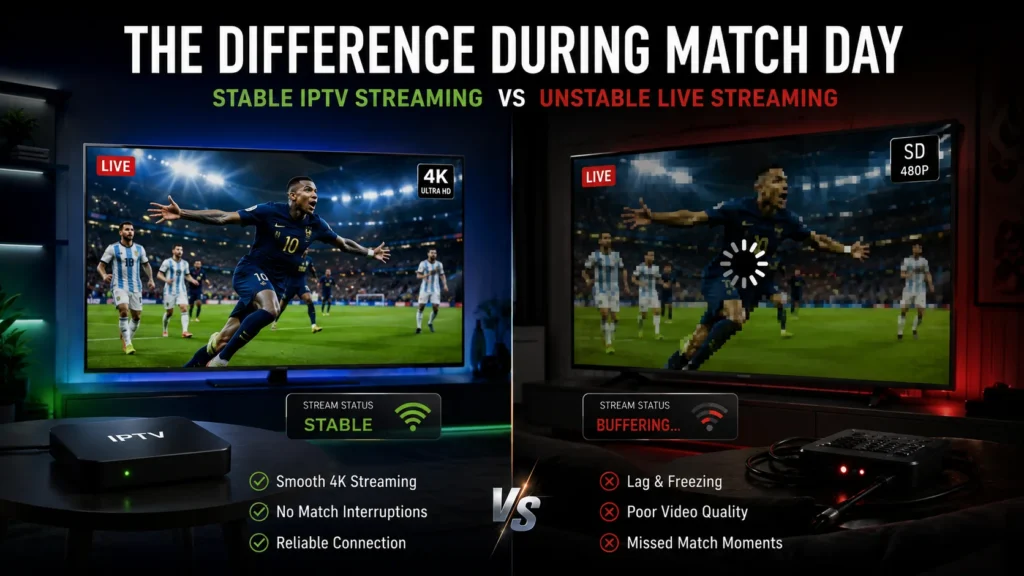
The Buffering Problem And How to Solve It
Ask anyone who’s tried to watch IPTV World Cup matches and they’ll mention buffering before they mention anything else. It’s the defining frustration of the format.
The causes are usually one of four things: insufficient broadband speed, a congested server on the provider’s end, ISP throttling, or a device that’s struggling to decode the stream. Fixing it requires working through those possibilities systematically rather than just rage-rebooting your router.
Start with a speed test. Use Fast.com or Speedtest.net and run it several times during the hours you’d normally watch matches. If your speeds are inconsistent, the problem is upstream of your setup.
If speeds are fine, switch to a wired connection if you haven’t already. Then try reducing the stream quality temporarily. Most decent IPTV apps, including TiviMate and IPTV Smarters Pro, allow you to manually select stream resolution. Dropping from 1080p to 720p can make the difference between a stuttering mess and a smooth 90 minutes.
One thing that genuinely surprised me during testing: playing around with the buffer size in TiviMate’s settings made a noticeable difference to stream stability during high-traffic periods. It’s buried in the settings menu, but increasing the buffer from the default to around 10 seconds can absorb minor server hiccups without interrupting your viewing.
Legal vs. Grey-Area IPTV: Knowing Where You Stand
Can you get in trouble for using an unlicensed IPTV service to watch the World Cup?
The honest answer is: it depends on where you live, and the legal landscape has shifted meaningfully over the past few years. In the UK, the Digital Economy Act and several high-profile court cases have placed greater liability on users of pirated IPTV streams, not just the providers. FACT (Federation Against Copyright Theft) has been increasingly active in pursuing enforcement actions, and the Premier League’s live blocking injunctions have demonstrated that IP-level blocking of unlicensed streams is both legally available and technically effective.
In practice, individual prosecution for watching rather than reselling remains rare. But the risk isn’t zero, and it’s growing. For IPTV World Cup access specifically, itself is known to invest heavily in broadcast rights protection during tournament periods. Rights holders have a strong financial incentive to act.
If you’re in a country where the World Cup isn’t fully broadcast (there are still regions with patchy coverage), the ethical case for grey-market streaming becomes more sympathetic. But eyes open you’re operating in legally uncertain territory.
Getting the Most From Your Setup on Match Days
Assuming you’ve got a solid setup, a few practical habits will make your IPTV World Cup experience significantly better.
Reboot your IPTV box or device about 20 minutes before kick-off. It sounds almost insultingly basic, but clearing cached data and refreshing the device’s connection to the server at a quiet time (rather than scrambling at kick-off) genuinely helps.
Check your IPTV provider’s server status. Many grey-market and some licensed services have status pages or community forums on Reddit subreddits like r/IPTV have active communities sharing real-time reports on service stability during major events. It’s worth a quick check an hour before the match.
Have a backup stream identified. Even with the best IPTV setup, servers can fail at the worst possible moment. Knowing which channel or app you’ll switch to if your primary source drops whether that’s a free broadcaster’s website, a catch-up service, or a secondary IPTV app means you don’t spend the first 10 minutes of the second half scrambling.
What the Big Broadcasters Don’t Want You to Know
There’s a reason so many people have turned to IPTV World Cup solutions rather than sticking with traditional broadcasting. The fragmentation of rights has become genuinely absurd.
In the UK alone, World Cup matches have been split between ITV, BBC, and various streaming platforms depending on the tournament year. In the United States, the broadcast patchwork is even more fractured, with matches spread across Fox Sports, Telemundo, and assorted streaming platforms that require separate subscriptions. The BBC’s own sports editor acknowledged in a 2022 piece that rights fragmentation was “actively driving viewers towards alternatives.”
This isn’t the consumer’s failure. It’s the predictable outcome of a rights marketplace that has prioritised maximum revenue extraction over viewer accessibility. When a significant portion of the tournament isn’t available on free-to-air channels in a given country, and the legal paid alternatives require three separate subscriptions, it’s not surprising that IPTV World Cup searches spike every four years with remarkable consistency.
The data from Google Trends confirms it: searches for IPTV-related World Cup terms peak sharply in the months before tournament kick-off, and sustain elevated levels throughout the group stages. The appetite is real, widespread, and entirely understandable.
Iptv world cup subscription customer support on WhatsApp
Frequently Asked Questions
Q1: What is the best IPTV setup for watching the World Cup?
The best IPTV World Cup setup combines a reliable broadband connection of at least 15 Mbps, a wired device connection where possible, and a quality IPTV app like TiviMate or IPTV Smarters Pro. If you’re using a licensed service, ensure your subscription includes the relevant broadcast rights for your region. Pairing any IPTV service with a reputable VPN adds both stability and protection against ISP throttling during high-demand matches.
Q2: Can I use IPTV to watch World Cup matches for free?
Some IPTV World Cup access is technically free if you’re in a country with free-to-air broadcasters streaming matches online, those streams are entirely legal and often excellent quality. The BBC iPlayer and ITV Hub, for instance, offer free legal access to covered World Cup matches for UK residents. Grey-market IPTV services that claim to offer free or very cheap access to all matches are operating outside licensing agreements and carry legal risk.
Q3: Will my IPTV stream buffer during World Cup matches?
Buffering is more likely during high-profile IPTV World Cup matches simply because server load spikes sharply at kick-off and at high-tension moments. You can reduce buffering by using a wired connection, increasing your app’s buffer size in settings, running a VPN to prevent ISP throttling, and choosing a provider with robust server infrastructure. Having a backup stream on standby is always sensible for any major final or semi-final.
Q4: Is it illegal to use IPTV to watch the World Cup?
It depends on the service and your location. Licensed IPTV services are entirely legal. Grey-market IPTV services that redistribute content without rights are illegal under copyright law in most jurisdictions, including the UK, EU, and United States. While individual viewer prosecutions remain uncommon, enforcement has increased substantially in recent years, particularly during major tournaments when rights holders invest in protection measures.
Q5: How many times does the IPTV World Cup topic trend online?
Searches for IPTV World Cup streaming solutions tend to rise significantly in the three months before a tournament begins and remain elevated throughout the group stage and knockout rounds. According to Google Trends data, related search terms typically see a three to five times increase above baseline during tournament periods, reflecting both the growth of IPTV adoption generally and the ongoing rights fragmentation that pushes viewers to seek alternatives.