Don't miss our holiday offer - up to 50% OFF!
Why Choosing the Right IPTV Service Matters More Than You Think

Picture this: it’s a Sunday afternoon, the big match kicks off in fifteen minutes, and your IPTV stream freezes. The buffering wheel spins. You restart the app. It freezes again. By the time the stream stabilises, you’ve missed the opening goal. Sound familiar?
That experience is precisely why picking the best IPTV service isn’t a casual decision. Millions of people have made the switch from traditional satellite and cable to internet-delivered television, and the gap between a well-run provider and a shoddy one is enormous. I’ve spent the better part of three years testing, subscribing, and sometimes cancelling services across this market, and I can tell you honestly: not all IPTV is created equal.
The best IPTV service UK for one household might be completely wrong for another. A family in Manchester who wants HD British channels and a solid EPG is making a very different demand than a sports fanatic who needs 4K streams and low latency. Both deserve good options. This guide will help you find yours.

What Separates a Great IPTV Service from a Disappointing One
Before we get into specific providers, it’s worth establishing what quality actually looks like in this space. Too many buyers get lured in by low prices and enormous channel counts, only to discover that half the channels buffer constantly and customer support is non-existent.
Here’s what genuinely matters:
Stream stability is non-negotiable. A provider might boast 15,000 channels, but if those streams drop out during peak viewing hours, the channel count is irrelevant. Consistent uptime, robust server infrastructure, and sensible load balancing are what keep viewers happy long-term.
Electronic Programme Guide (EPG) accuracy is underrated. An outdated or broken EPG makes the viewing experience feel broken even when the streams themselves are fine. Good providers maintain their EPG data carefully and update it regularly.
Catch-up and VOD libraries have become essential differentiators. The best IPTV service providers now offer thousands of hours of on-demand content alongside live channels, essentially combining the functions of a traditional IPTV subscription with something closer to a streaming platform.
Customer support quality rounds things off. You’ll need help at some point. Whether it’s a technical issue or a billing query, a responsive support team separates professional operations from fly-by-night setups.
The Best IPTV Services Reviewed for 2026
IPTV Smarters Pro (as a Platform with Reliable Providers)
IPTV Smarters Pro isn’t a content provider itself; it’s one of the most respected IPTV player applications available on Android, iOS, and smart TV platforms. When paired with a quality content subscription, it produces one of the cleanest viewing experiences on the market. The interface is responsive, the EPG integration is solid, and the multi-screen support is genuinely useful for families.
The catch? You need to bring your own subscription. But for technically confident users who want full control over their setup, this approach often yields better results than all-in-one services.
Xtreme HD IPTV
Xtreme HD IPTV has built a reputation as one of the more reliable services for UK and US viewers. Their channel library is extensive, with particular strength in sports and international content. Stream quality on premium HD and FHD channels is consistently good, and their server uptime has been notably stable compared to many competitors I’ve tested.
They offer a free trial, which is the right way to approach any IPTV purchase. Never commit to a full year’s subscription without testing the service first.
APOLLO GROUP TV
Apollo Group TV is frequently cited by enthusiasts on forums like Reddit’s r/IPTV as one of the best IPTV services for sports. They carry an impressive range of PPV events, and their 4K channel selection is broader than most. Pricing sits in the mid-range, which feels fair given the quality on offer.
One honest caveat: during very high-demand events, I’ve noticed occasional brief drops. It’s rare, but worth acknowledging. No provider is flawless at peak load.
HELIX IPTV
Helix is worth a mention for those prioritising a large VOD library alongside live television. Their catalogue of films and series is genuinely competitive, and the interface available through their dedicated app is cleaner than many in this category. For viewers who want the best IPTV service to double as a Netflix alternative, Helix deserves serious consideration.
Purple Paw IPTV
Purple Paw has a strong following among UK viewers specifically. Their British channel lineup is comprehensive, EPG data is reliably accurate, and their customer support via ticket system responds within a few hours rather than days. It’s the kind of quiet, reliable service that doesn’t need flashy marketing because the product does the talking.
A Closer Look: Streaming Quality and Stability
When I talk about stream quality, I’m not just referring to resolution. Resolution is easy to advertise. What’s harder to maintain is consistent bitrate, low latency, and the absence of artefacts during fast-moving content like sport.
The best IPTV service providers use multiple server redundancies, meaning if one server comes under pressure, traffic shifts to another automatically. Cheaper services don’t invest in this infrastructure, which is exactly why they buckle during major live events when tens of thousands of viewers are tuned in simultaneously.
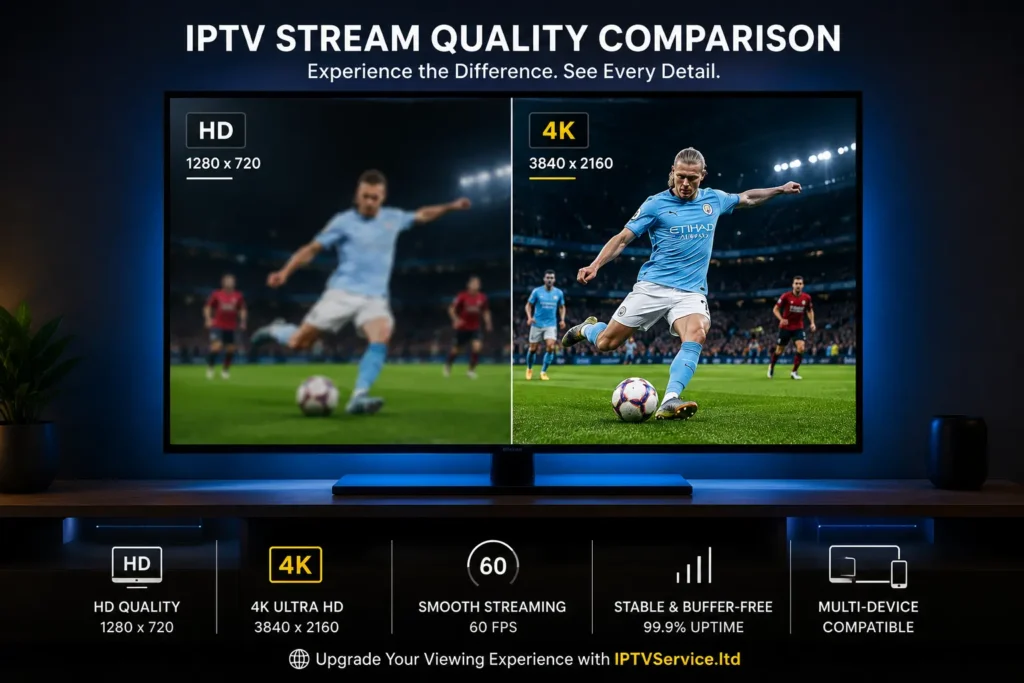
4K streaming via IPTV is still maturing. Providers offer it, and it looks spectacular when conditions are right, but it demands a strong, stable internet connection on your end. A minimum of 25 Mbps dedicated to the stream is realistic, and 50 Mbps is better. If your connection fluctuates, a 1080p FHD stream will usually deliver a more consistent experience than 4K.
According to Ofcom’s 2024 Connected Nations report, average UK fixed broadband speeds have now exceeded 70 Mbps for most households, which means the infrastructure for high-quality IPTV is increasingly in place on the consumer side.
Device Compatibility: Where Can You Actually Watch?
One of the practical advantages of using the best IPTV service is flexibility. Unlike satellite or cable, you’re not tied to a specific box in a specific room.
Here’s how compatibility typically breaks down across providers:
| Device Type | Typical Support | Notes |
|---|---|---|
| Android TV / Fire Stick | Excellent | Widest compatibility across all providers |
| Smart TV (Samsung/LG) | Good | Varies; some require sideloading |
| iOS / iPhone | Moderate | App restrictions apply; often needs third-party player |
| Windows / Mac | Good | Browser or dedicated app depending on provider |
| MAG Boxes | Good | Common in dedicated IPTV setups |
| Roku | Limited | Few providers support natively |
The Amazon Fire Stick remains the most popular device for IPTV users in the UK, largely because sideloading Android APKs is straightforward and the hardware is affordable. A Fire Stick 4K Max paired with a quality subscription produces excellent results for most households.
Pricing Breakdown: What You Should Expect to Pay
The pricing landscape for IPTV services has stabilised considerably over the past two years. Here’s what honest market rates look like:
- Monthly subscriptions typically run between £8 and £20 per month, depending on channel count, stream quality ceilings, and the number of simultaneous connections included.
- Quarterly plans usually offer a modest discount of around 10 to 15 percent compared to monthly pricing. A sensible choice if you’ve tested the service and are satisfied.
- Annual plans can bring costs down to the equivalent of £5 to £10 per month. These offer the best value but carry the most risk if the service deteriorates or shuts down.
- Multi-connection plans are increasingly standard, allowing two, three, or even five simultaneous streams. For families where multiple people watch different things at the same time, these plans are essential.
Be sceptical of any service priced below £5 per month. At that price point, infrastructure investment is almost impossible to sustain, and you’ll pay for the saving in reliability.
IPTV pricing guide and what to expect → /best iptv subscription pricing guide/
Red Flags to Watch Out For
Not every provider offering the best IPTV service is actually delivering it. Some warning signs I’ve learned to spot over the years:
No free trial or demo period. Any serious provider is confident enough in their product to let you test it. Those who refuse typically know the service wouldn’t survive scrutiny.
Impossibly large channel counts. “25,000 channels!” sounds impressive until you realise three-quarters of them are dead links or foreign-language streams with no EPG. Channel quality matters far more than quantity.
No visible contact information. A proper business has a support ticket system, an email address, and ideally a live chat option. Anonymous WhatsApp numbers are not professional customer support.
Upfront payment for long periods with no refund policy. Some services push hard for annual payment on first contact. That’s a flag. Test monthly first, always.
Overwhelmingly positive reviews with no negatives. Real services have real complaints. A review profile that’s uniformly glowing is either curated or fabricated. Tech publication PCMag has written sensibly about the broader risks of unverified streaming services, and it’s worth reading their consumer guidance if you’re new to this space.
Buy IPTV Reseller UK Credits & Launch Your IPTV Business Easily
Frequently Asked Questions
Q1: What is the best IPTV service for UK viewers in 2026?
For UK viewers, the strongest options currently include Purple Paw IPTV for its British channel depth and reliable EPG, and Xtreme HD IPTV for its broader international range. The best IPTV service for any individual depends on what channels they prioritise and how stable their broadband connection is. I’d recommend trialling at least two providers before settling on one. Monthly subscriptions make this risk-free.
Q2: How do I know if an IPTV service is reliable?
Reliability signs include positive independent reviews on forums like Reddit’s r/IPTV, the availability of a free trial, responsive customer support, and a transparent pricing structure. The best IPTV service providers don’t hide behind anonymous contact details or make unrealistic claims about channel counts. Testing during a live sports event is the most honest reliability test you can run.
Q3: Is IPTV legal to use?
The legality of IPTV depends entirely on the provider. Services that hold the appropriate broadcasting licences for the content they distribute are fully legal. Services that redistribute copyrighted content without permission operate in legally grey or outright illegal territory. The hardware and software used to watch IPTV are not themselves illegal; it’s the content licensing that determines legality. If you’re unsure about a specific provider, checking whether they operate transparently as a registered business is a reasonable first step.
Q4: What internet speed do I need for the best IPTV service experience?
For standard HD streams, a stable 10 Mbps connection is generally sufficient. FHD streams benefit from 15 to 25 Mbps, and 4K streams require at least 25 Mbps with low jitter. Wired ethernet connections always outperform Wi-Fi for IPTV, even when Wi-Fi speeds appear comparable. The consistency of the connection matters as much as the headline speed.
Q5: Can I use the best IPTV service on multiple devices at once?
Most quality providers offer multi-connection plans that allow two, three, or more simultaneous streams on the same subscription. If you’re a household where different family members want to watch different content at the same time, look specifically for plans that specify concurrent connections rather than assuming it’s included. Exceeding the allowed connection count often results in automatic disconnection of one stream.