Don't miss our holiday offer - up to 50% OFF!

What an IPTV Reseller Business Actually Is

Three years ago, a friend of mine spent an entire weekend setting up what he called his “side income experiment.” He bought a iptv reseller subscription package from an IPTV provider, built a bare-bones website, and told a few people in a local Facebook group about it. Within six weeks, he had forty paying subscribers. Within six months, he’d left his part-time job.
I’m not telling you that story to hype you up. I’m telling you because it illustrates something real: the iptv reseller business model has a remarkably low barrier to entry compared to almost any other digital subscription business. You don’t build the infrastructure. You don’t host the streams. You don’t manage servers at three in the morning when a football match kicks off. You buy wholesale credits from an established provider, repackage them under your own brand, and sell subscriptions directly to customers.
That’s the core of it. But as with anything that sounds deceptively simple, the details are where most people either thrive or quietly give up.
The Real Market Opportunity Right Now
The numbers are genuinely striking. According to a 2024 report from Grand View Research, the global IPTV market was valued at over $74 billion and is projected to grow at a compound annual rate above 7% through the end of the decade. Cord-cutting isn’t a trend anymore it’s the default behaviour for a generation of viewers who’ve never paid for a cable package in their lives.
What does that mean for the iptv reseller business market specifically? It means demand is structurally embedded now. People aren’t going back to satellite dishes and two-year cable contracts. They want flexible, affordable, on-demand access to content and many are willing to pay a small monthly fee to someone they trust personally, rather than navigate confusing tier-based streaming packages from big providers.
That “someone they trust” is exactly where a reseller steps in.
The model also has a pleasant recurring revenue character. Unlike selling a product once, subscriptions renew. A customer who signs up in January and stays through December is paying you twelve times for the same setup work you did once. This compounding effect is why the iptv reseller business attracts people from affiliate marketing, web hosting reselling, and digital services more broadly.
Choosing the Right IPTV Panel and Provider
This is the decision that will define your entire operation, and it’s worth spending more time on than most guides suggest.
When you become an iptv reseller UK, you’re typically given access to a reseller panel a dashboard from which you create, manage, and renew customer subscriptions. The quality of that panel directly affects your daily workflow and your customer experience. You’ll want to evaluate panels on four dimensions:
- Uptime and stream reliability — ask for a trial period, not just their word on this. Test streams across multiple devices and connection speeds before committing to a bulk credit purchase.
- Channel and VOD library depth — does it cover the regions and content types your target customers actually want? A panel loaded with 10,000 channels is useless if they’re all in languages your audience doesn’t speak.
- Reseller support responsiveness — submit a pre-sales support ticket and time the response. This tells you everything about what post-sales support will look like.
- Panel features — look for a built-in trial manager, customer expiry tracking, and ideally a white-label option so your brand is front and centre.
Platforms like XCIPTV and TiviMate are popular on the customer-facing side; understanding which apps your provider supports is worth confirming before you sign up.
One thing I’d flag honestly: the iptv reseller business sits in a legally grey area in many jurisdictions. Providers vary enormously in their content licensing arrangements. This guide isn’t legal advice, and I’d strongly recommend consulting a local legal professional before launching commercially at scale. Some resellers operate in fully licensed environments; others don’t. The risk profile is yours to assess.
Pricing Your Service Without Underselling Yourself
Here’s where a lot of new resellers make a costly mistake. They see competitors charging £7 or £8 a month and immediately try to undercut by a pound. What they don’t realize is that those competitors may be operating at volume that makes thin margins workable or they’re providing inferior service and will lose customers within three months anyway.
Price based on value, not fear of competition.
A typical reseller credit might cost you the equivalent of £2 to £4 per active subscription per month, depending on volume tiers. If you’re selling at £8, you’re working with a margin of £4 to £6 per customer. With fifty customers, that’s £200 to £300 monthly. With two hundred customers, the maths becomes considerably more interesting.
Consider offering tiered packages rather than a single flat price. A basic package covering one connection is your entry point. A family iptv reseller package covering three or four simultaneous connections can be priced at nearly double customers perceive clear value, and your cost increase is minimal because most providers charge per connection, not per customer.
Don’t offer unlimited free trials. Offer short, time-limited trials 24 or 48 hours and then follow up personally. That personal follow-up converts surprisingly well. People appreciate dealing with an actual human rather than an automated funnel.
Building a Customer Base That Stays
The iptv reseller business is a retention game, not an acquisition game. Getting your first customer is the easy part especially if you start with your existing network. Keeping them, and having them tell others, is the actual business.
Word of mouth is still the most powerful acquisition channel in this space. Most successful resellers I’ve spoken with report that between 40% and 60% of their customers came through referrals. That means your single most important marketing investment is making the existing customer experience excellent.
A few practical approaches that consistently work:
- Respond to support messages within a few hours. IPTV customers tend to contact you during evenings and weekends when they’re actually watching. Being available in those windows matters more than office-hours responsiveness.
- Send renewal reminders proactively. Don’t wait for a subscription to lapse and a frustrated customer to message you. A short, friendly message three days before expiry prevents churn almost entirely.
- Create a simple onboarding guide. Most first-time IPTV users struggle with setup. A well-written guide covering the three or four most popular apps sent automatically when someone subscribes dramatically reduces early cancellations.
For broader reach, Facebook groups, local community forums, and even WhatsApp groups within diaspora communities (who often have strong demand for specific regional channels) are highly effective. Paid advertising on Facebook can work for the iptv reseller business too, though you’ll need to be careful about platform policies around this category.
Payments, Support, and the Admin Layer People Ignore
Let’s talk about the unglamorous bits.
Payment collection is the part new resellers routinely underplan. You can start by collecting payments through PayPal or bank transfer, and for your first twenty customers this is fine. Beyond that, manual collection becomes a genuine time sink and a source of awkward conversations when renewals lapse.
Platforms like Stripe allow you to set up recurring subscription billing, though you’ll need to check their terms regarding IPTV-type services. Some resellers use crypto payments for flexibility. Others use invoicing tools like Wave or FreshBooks to automate the reminder-and-collection cycle. Whatever system you choose, the key principle is: remove yourself from the manual loop as early as possible.
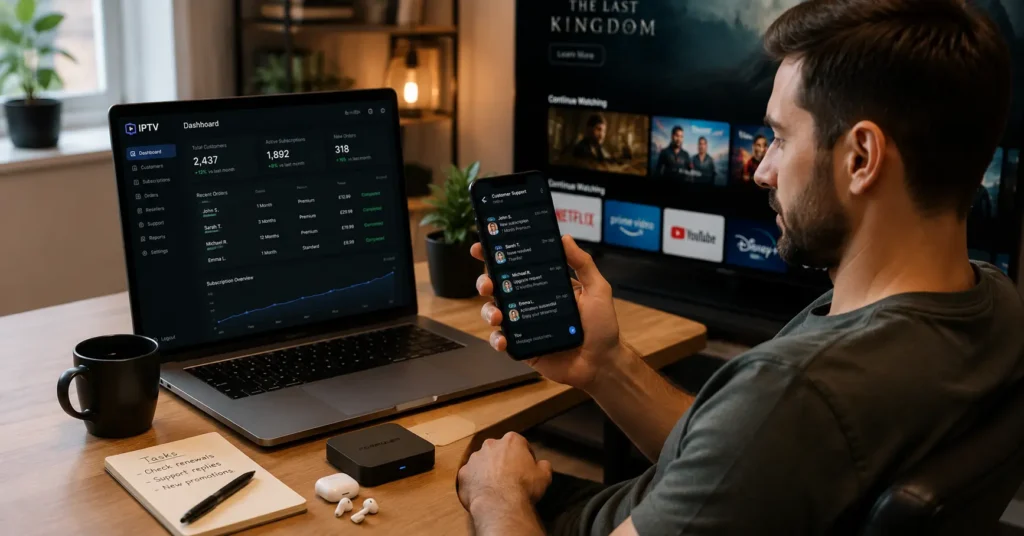
Support is the other operational area that scales poorly if unmanaged. At fifty customers, answering support queries via WhatsApp is manageable. At two hundred, it becomes a part-time job. At that stage, a simple helpdesk tool even a free tier of Freshdesk or Zoho Desk allows you to track, prioritise, and close support requests without things falling through the cracks.
Have templated responses ready for your most common queries. These will almost certainly be: “how do I set this up on my Firestick,” “my stream keeps buffering,” and “I forgot my login details.” Write good answers once and reuse them forever.
Scaling Beyond Your First 50 Customers
Reaching your first fifty customers in the iptv reseller business is a milestone worth acknowledging. It proves the model works. At that point, you’re probably generating enough monthly recurring revenue to justify reinvesting.
So what does scaling actually look like?
The most straightforward path is creating sub-reseller arrangements. Your provider’s panel likely supports this. You can sell credits at a small markup to other resellers who then sell directly to end users. This adds a layer of leverage you’re building a small distribution network rather than serving every customer yourself.
Another scaling lever is specialisation. Rather than positioning yourself as a generic IPTV service, consider focusing on a specific audience. Sports-focused subscribers, South Asian content buyers, or expats wanting their home country’s channels all represent tightly defined communities with strong retention potential and word-of-mouth reach. Specialised positioning lets you charge slightly more and serves customers who feel the offering was built specifically for them.
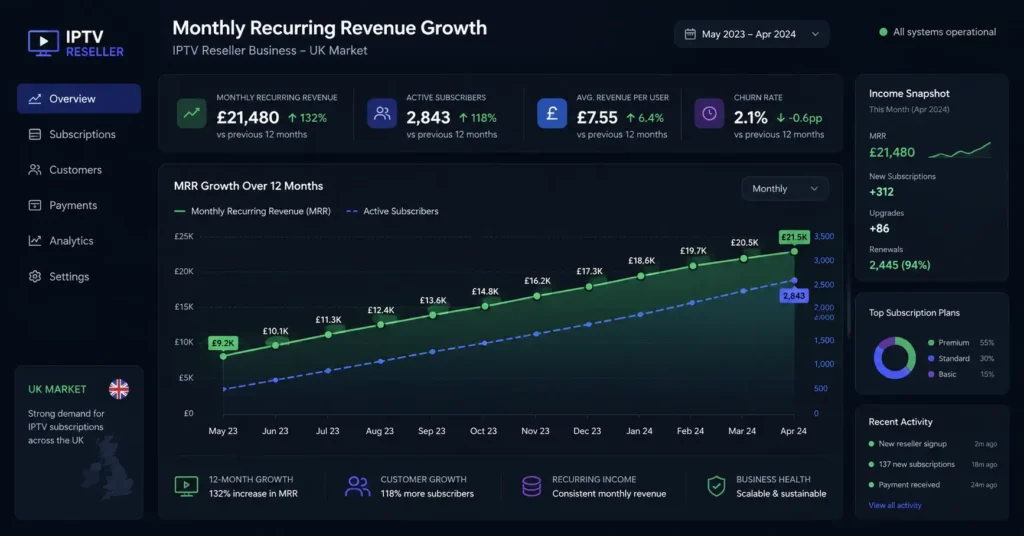
What makes this business genuinely scalable is that the operational complexity doesn’t grow linearly with customer count. Your panel handles the technical delivery. Your payment system handles renewals. Your helpdesk handles queries. With the right systems, going from fifty to two hundred customers is a volume increase, not a complexity increase.
Is the iptv reseller business right for everyone? Honestly, no. If you’re looking for a completely passive business, this isn’t it at least not without investment in automation and potentially a part-time virtual assistant. It requires reliable responsiveness, active customer management, and the willingness to handle occasional technical complaints with patience. But for someone who enjoys the customer relationship side and wants a recurring income stream with low startup costs, the model has genuinely compelling fundamentals.
Techradar has covered the IPTV ecosystem extensively, and their reporting on streaming trends offers useful context for understanding where the consumer market is heading. Similarly, CNBC has profiled the broader cord-cutting shift in ways that help frame the macro tailwind behind this business.
Frequently Asked Questions
Q1: What is an IPTV reseller business and how does it work?
An IPTV reseller business involves purchasing streaming access credits in bulk from an IPTV provider and then selling individual subscriptions to end users under your own branding. The reseller manages customer accounts through a provider-supplied panel, handling billing and support while the provider manages the technical infrastructure. It’s a wholesale-to-retail model applied to streaming services. Most resellers start with a modest credit package and reinvest earnings to increase their buying capacity over time.
Q2: How much money can you realistically make from an IPTV reseller business?
Earnings depend heavily on how many active subscribers you maintain and your pricing structure. With fifty customers paying £8 monthly and a cost base of £3 per subscriber, you’re generating roughly £250 in monthly profit. At two hundred customers, that figure rises toward £1,000 monthly before any sub-reseller revenue. These are realistic numbers for a part-time operation; full-time operators with strong retention and sub-reseller networks can earn considerably more.
Q3: Is starting an IPTV reseller business legal?
The legal status of the iptv reseller business varies significantly by country and by the licensing arrangements of your specific provider. Some IPTV providers operate with full content licensing; others do not. Resellers are responsible for understanding the regulatory environment in their own jurisdiction. This is an area where independent legal advice is genuinely worth seeking before you launch commercially at any meaningful scale.
Q4: What do I need to start as an IPTV reseller?
To get started you need a reseller account with a reputable IPTV provider, an initial credit purchase, a basic customer-facing presence (even a simple landing page or social profile), and a payment collection method. Many resellers start with under £100 in total investment. As your customer base grows, you’ll want to add helpdesk software, automated billing, and a more polished brand presence.
Q5: How do I find customers for my IPTV reseller business?
The most effective early channels are personal networks, local Facebook groups, and community forums. Word-of-mouth referrals from satisfied customers typically become the dominant acquisition source within a few months. Some resellers run targeted social media advertising successfully, though platform policies in this category require careful navigation. Specializing in a specific audience sports fans, expat communities, or regional content buyers often yields better retention and more organic referrals than a general positioning.