Don't miss our holiday offer - up to 50% OFF!


How UK Resellers Really Make Money (and Where They Lose It)

Last spring a reader emailed me a photo of his kitchen table. On it sat a laptop, three empty mugs and a hand-drawn spreadsheet with the word “profit???” circled in biro. He’d been offered a place on an IPTV Reseller UK Program and wanted to know whether the numbers on the sales page were real.
Here’s the short answer I gave him, and the one I’ll give you. An IPTV Reseller UK Program lets you buy access in bulk, usually as credits, and resell subscriptions to your own customers through a control dashboard, so your profit is the gap between what you pay wholesale and what you charge. It can be a perfectly sensible small business, but only if the provider is properly licensed, the panel is stable and you’re ready to handle support. Miss any one of those three and the maths stops mattering very quickly.
For the better part of fifteen years I’ve written about broadband, streaming and the companies behind them. Over that time I’ve watched plenty of people start reselling with real enthusiasm and quit within a quarter. This guide is everything I wish that reader had known before he bought his first batch of credits.
What an IPTV Reseller UK Program Actually Is (and Isn’t)
Strip away the marketing and the model is simple. A wholesale provider runs the servers, the delivery network and the apps. You sit in the middle, holding a reseller account, and you sell access to end users under your own name or brand.
What you’re not doing is running infrastructure. You don’t host streams, you don’t manage encoders and you aren’t the one keeping servers online at nine o’clock on a busy Saturday night. That’s the provider’s job, which is precisely why choosing the right one matters more than anything you’ll do yourself.
Think of an IPTV Reseller UK Program as a wholesale arrangement rather than a franchise. There’s rarely formal training, territory protection or brand support of the kind a high-street franchise would offer. You get a login, a credit balance and, if you’re lucky, a responsive account manager on WhatsApp.
So who is it really for? In my experience, it suits people who already have an audience or a customer base: a phone repair shop, a small IT support business, an aerial and satellite installer, or someone in a local community who gets asked for streaming advice every week. It’s a far harder road if you’re starting with no contacts and hoping paid ads will do all the heavy lifting.
Credits, Connections and the Maths Behind the Margin
Nearly every IPTV Reseller UK Program I’ve reviewed runs on credits. One credit typically equals one month of service for one connection, although some providers discount longer terms, charging perhaps 10 or 11 credits for a 12-month line. Multi-device connections usually cost more credits per month.
Below is a simplified example of how credit tiers tend to look. These figures are illustrative rather than quotes from any specific provider, and real wholesale prices move around a fair bit.
| Credit pack | Typical cost per credit | Retail price you might charge (1 month) | Rough gross margin per month |
|---|---|---|---|
| 50 credits | £3.50 | £10 | £6.50 |
| 100 credits | £3.00 | £10 | £7.00 |
| 250 credits | £2.50 | £10 | £7.50 |
| 500 credits | £2.00 | £10 | £8.00 |
Looks generous, doesn’t it? The catch is that gross margin isn’t profit. Payment fees, refunds for customers whose devices won’t cooperate, free trials that never convert and your own hours on support all come out of that number.
My rule of thumb, after talking to a good number of resellers, is to assume you’ll keep roughly half of what the table suggests during your first six months. If the business still looks worthwhile at that figure, you’re on solid ground. If it only works at the top-tier margin, you’re betting on volume you don’t have yet.
Credit expiry is the other thing to check. Most providers let credits sit in your balance indefinitely, but some set expiry windows, so read the terms before buying a 500-credit pack just to chase a lower unit price.
Inside the IPTV Panel: What You’ll Use Every Day
Your IPTV panel is the shop counter, stockroom and till rolled into one. You’ll spend more time in it than you expect, so it pays to know what a good one looks like before you commit to anything.
Creating and managing lines
Most dashboards let you create a new line in under a minute: choose a package, set the duration, pick the number of connections and generate credentials. Good ones show the expiry date clearly and let you extend a line without creating a fresh one. Clunky ones force you to delete and recreate, which irritates customers who’ve already set up their apps.
Credentials and playlist formats
Any decent IPTV panel will give you Xtream Codes API login details (server URL, username and password) alongside an M3U link. Xtream Codes logins tend to suit customers using apps like TiviMate or IPTV Smarters Pro, because the programme guide and categories load automatically. M3U links are more universal but trickier for anyone who isn’t comfortable with technology.
Sub-reseller accounts
Larger programmes let you create sub-resellers beneath you and transfer credits to them. It’s tempting to grow this way, but every sub-reseller’s customers ultimately become your support problem when something breaks. Hold off until your own processes are properly nailed down.
Logs and activity history
Look for connection logs, credit history and a clear record of every line you’ve created, extended or disabled. When a customer insists they paid for a year and you can only see six months, those logs are your only defence.
Before you sign up for any IPTV Reseller UK Program, ask for a demo login or a short trial of the dashboard itself. Ten minutes clicking around will tell you more than any sales page ever could.
The Legal Bit Nobody Wants to Read (but Should)
Let me be blunt, because this is where people get hurt. Selling an IPTV service in the UK is legal when the provider holds the rights to the content it distributes, and it is very much not legal when it doesn’t. The technology itself, meaning the apps, the protocols and the panels, is neutral. Content rights are what decide everything.
The UK Intellectual Property Office has published guidance on illicit streaming for years, and it has been consistent that sellers, not only operators, can face consequences. Industry bodies such as FACT have also pursued resellers through the courts. Nobody wants to be the cautionary tale in next year’s press release.
So what should a legitimate IPTV Reseller UK Program be able to show you? At a minimum, a clear business identity, a registered company you can look up on Companies House, written terms and a straight answer when you ask about content licensing. If a provider dodges that question, changes the subject or tells you “everyone does it”, walk away.
Data protection deserves a mention too. You’ll be holding customer names, email addresses and possibly payment details, which makes you responsible for them under UK GDPR. The Information Commissioner’s Office has plain-English guidance for small businesses, and it’s well worth an hour of your evening.
None of this is meant to scare you off. It’s meant to make sure the business you build is one you can talk about openly, put on a proper website and grow without looking over your shoulder.
Why Your Customers Blame You for Their Wi-Fi
Here’s something no reseller sales page mentions. A large share of the support messages you’ll receive won’t really be about the service at all. They’ll be about home networks.
Picture a customer streaming on a Fire TV Stick tucked behind the telly, three rooms away from the router, on a crowded 2.4GHz band. They’ll get buffering on any IPTV service in the world. But they won’t blame their router; they’ll blame you.
Ofcom’s research on home broadband has long pointed out that in-home Wi-Fi, rather than the line coming into the house, is often what slows people down. You can’t move their walls, but you can hand them a simple routine to follow before they message you in a panic.
When I helped a friend in Wolverhampton set up his reseller account, we started sending every new customer a short guide covering speed tests with Speedtest by Ookla, switching to the 5GHz band, using an Ethernet cable or powerline adapter where possible, and restarting the router properly. His support messages dropped noticeably within a fortnight. If you’d like a ready-made version to adapt, this walkthrough is a sensible starting point:
Your IPTV Connection in the UK, Sorted: Speed, Wi-Fi and Provider Checks That End Buffering → /iptv connection
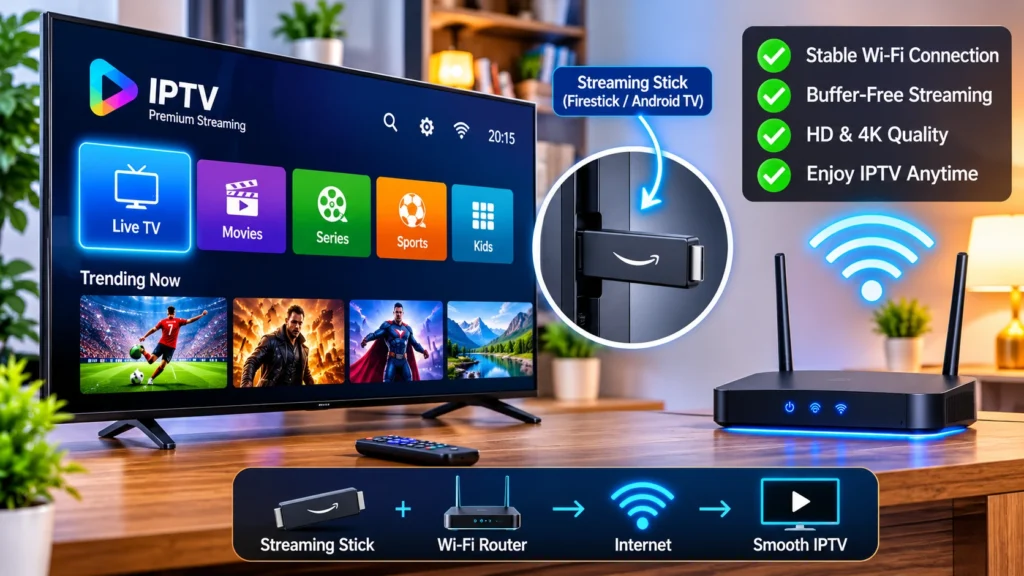
Put simply, the best IPTV Reseller UK Program going won’t save you from a customer’s dodgy router. Good onboarding will.
Support Is the Real Product You’re Selling
Customers can buy streaming access in a dozen places. What they’re really paying you for is a person who picks up when something goes wrong. That’s uncomfortable to hear if you’d pictured a hands-off side income, but it’s the truth of the job.
Response time is the first thing customers judge. You don’t need to be available around the clock, but you do need to set expectations and stick to them. Publishing your support hours, say 10am to 10pm, and keeping to them builds far more trust than replying instantly one day and vanishing the next.
Tools help enormously here. WhatsApp Business lets you save quick replies for the questions you’ll answer constantly, such as how to log in on a particular app, how to reset the playlist or what to do when the guide looks empty. A shared notes document means you’re not relying on memory for who uses which device.
Escalation matters just as much. Know exactly how to reach your provider when a server is genuinely down, and find out how quickly they respond before you have 40 people messaging you at once. A quick “we’re aware, the provider is working on it, I’ll update you within the hour” calms people far better than silence.
Ask yourself honestly whether you’ll enjoy this part. If the idea of troubleshooting someone’s smart TV on a Sunday evening fills you with dread, reselling probably isn’t the right fit, and there’s no shame in deciding that early.
Choosing an IPTV Reseller UK Program Without Getting Burnt
Every provider will tell you they’re the most reliable in Britain. These are the checks I’d actually run, in roughly the order I’d run them.
- Licensing transparency. Ask directly about content rights and get the answer in writing. This one is pass or fail, and it outranks everything else on the list.
- Uptime track record. Ask how the provider handled their last major outage and how quickly they told resellers. Vague answers are an answer in themselves.
- Server locations and load. UK customers generally fare best with servers in the UK or nearby Europe. Ask how busy those servers get during peak evening hours.
- Panel quality. Request dashboard access before buying. Check line creation, extensions and logs, and see whether the IPTV panel works properly on a phone screen.
- Support response times. Send a pre-sales question on a weekday evening and time the reply. That’s roughly how fast they’ll respond when your customers are waiting.
- Credit pricing and minimums. Compare the cost per credit at the pack size you’ll actually buy, not the shiny top tier on the pricing page.
- Refund and replacement policy. Find out what happens to credits if you create a line by mistake or a customer cancels within 24 hours.
Treat the first point as a gate and the other six as a score. A provider who aces six checks but fails on licensing isn’t a provider worth considering at all. App compatibility is worth a quick test too: confirm the service plays nicely with whatever your customers already use, whether that’s TiviMate, IPTV Smarters Pro or the provider’s own branded app.
Where I Think Most New Resellers Go Wrong
Honestly, it’s rarely the IPTV Reseller UK Program itself that sinks people. Most failures I’ve seen come down to three habits, and all three are fixable.
Underpricing comes top. New resellers often undercut everyone to win customers quickly, then discover there’s nothing left once support time is counted. Price at a level where you can afford to be helpful, because helpful is what keeps people renewing.
Skipping onboarding is a close second. Sending a username and password with a cheery “enjoy!” is how you end up answering the same five questions forty times a week. A one-page setup guide for each device saves hours every month.
Neglecting the dashboard is the quiet killer. Resellers who check expiry dates weekly, send renewal reminders a few days early and keep tidy notes on each customer tend to keep those customers. Those who don’t end up chasing lapsed accounts and wondering where the money went.
Consider a hypothetical to make it concrete. Two resellers join the same IPTV Reseller UK Program and each has 60 customers. One spends Sunday evenings checking renewals and sending friendly reminders, while the other waits for people to complain that their service has stopped. Six months on, I’d wager the first still has close to 60 customers and the second is down to around 35, with the same provider and the same prices.
A First-Month Checklist for New UK Resellers
If you’ve just joined an IPTV Reseller UK Program, these are the jobs I’d get done within the first four weeks.
- Get the provider’s company details and licensing position confirmed in writing
- Buy a small credit pack first rather than chasing the biggest discount
- Test lines yourself on at least two devices, such as a Fire TV Stick and an Android phone
- Write a one-page setup guide for every device your customers are likely to use
- Prepare a short Wi-Fi and speed troubleshooting message to send with each new line
- Build a simple customer record in Google Sheets with start date, expiry date and device
- Decide your trial and refund policy before your first sale, not after a dispute
- Check whether you need to register with the ICO and keep customer data properly secured
One Last Thought Before You Commit
Reselling isn’t a get-rich-quick scheme, whatever the adverts suggest. It’s a small service business, and like any service business it rewards people who answer messages promptly, price fairly and choose their suppliers with care.
If you take one thing from this guide, let it be this: judge an IPTV Reseller UK Program by how it behaves when things go wrong, not by how polished it looks when everything’s fine. Ask awkward questions, test the panel, check the paperwork and start small. Do that, and you’ll be building something with a future rather than chasing a margin that quietly disappears.
As for that reader with the biro spreadsheet? I hope the numbers worked out for him, and I hope he bought the small pack first.
Frequently Asked Questions
Is an IPTV Reseller UK Program legal?
It depends entirely on the provider behind it. Reselling is legal when the wholesale provider holds the proper rights to the content it distributes, and illegal when it doesn’t. The technology involved, including apps and panels, is neutral in itself. Always ask for licensing information in writing before you buy any credits.
How much money do I need to start an IPTV Reseller UK Program?
Many providers let you start with a small credit pack, often in the region of 50 credits, which keeps your initial outlay modest. On top of that, set aside a little for payment fees, test devices and a basic website or social media presence. Starting small lets you test the provider’s reliability before committing serious money. You can always scale up once renewals start coming in.
What’s the difference between an IPTV service and an IPTV panel?
An IPTV service is what your customer actually watches, delivered through an app on their TV, stick or phone. An IPTV panel is the reseller dashboard you use behind the scenes to create lines, set expiry dates and manage credits. Customers never see the panel, but its quality directly affects how quickly you can help them. A great service paired with a clumsy panel will still make your working life harder.
Can I run an IPTV Reseller UK Program alongside a full-time job?
Yes, plenty of resellers do, particularly in the early months. The key is setting clear support hours and sticking to them, so customers know when to expect a reply. Evenings are usually the busiest time for streaming problems, which can clash with family time. If your customer base grows past a hundred or so, you may need help or a more structured support routine.
What should I do if customers keep reporting buffering?
First, check whether the issue affects many customers at once, because that usually points to a provider or server problem. If it’s one or two people, the cause is often their home Wi-Fi, device or router placement. Send them a simple checklist covering speed tests, switching to 5GHz and using a wired connection where possible. Keep notes on recurring cases, as patterns will tell you whether your provider is still the right choice.