Don't miss our holiday offer - up to 50% OFF!

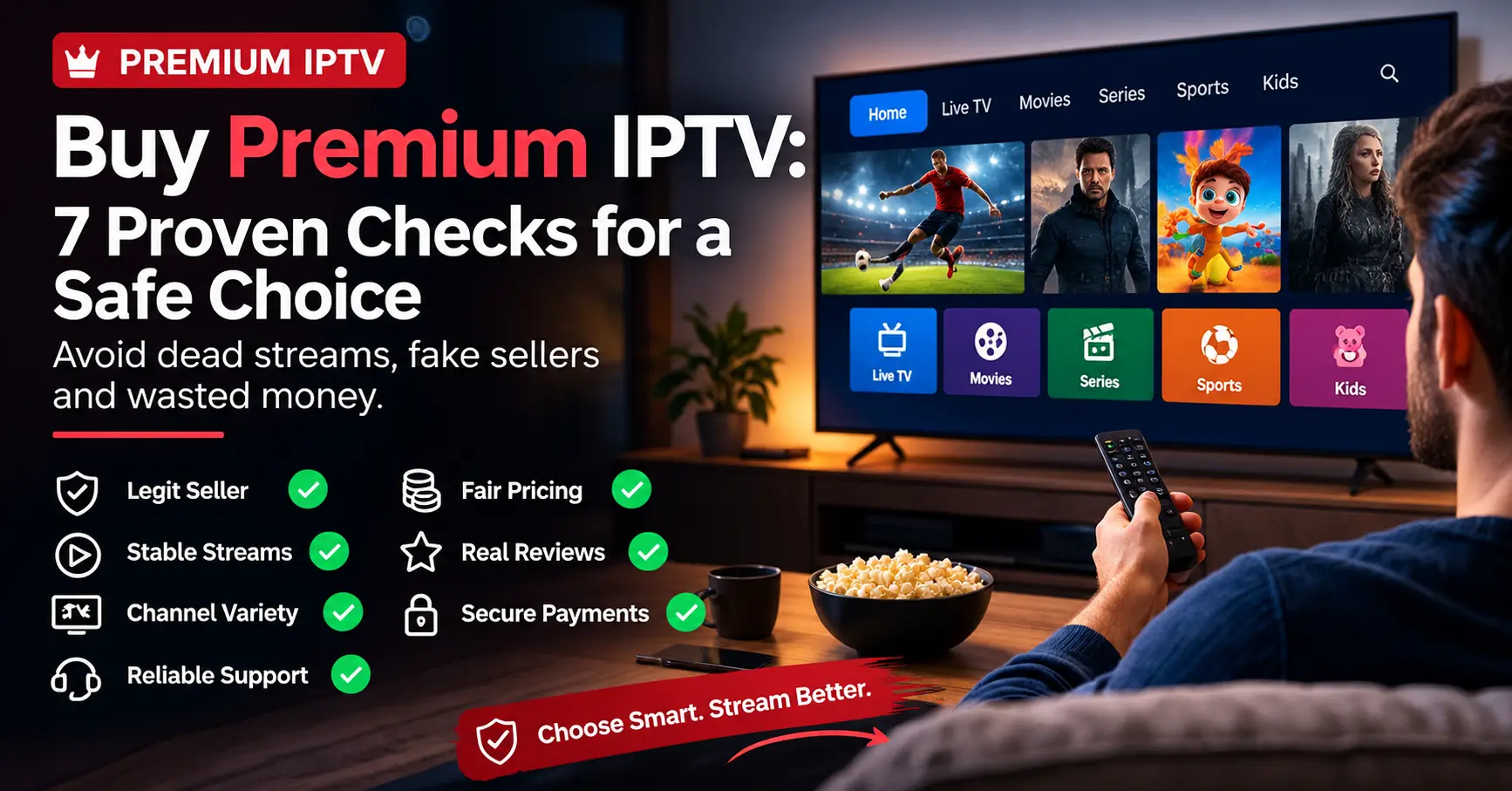
Buy Premium IPTV: The Honest Guide to Avoiding Dead Streams, Fake Sellers and Wasted Money

My brother-in-law rang me at half past nine on a Saturday night, absolutely furious. The big match had frozen with ten minutes to go, and the service he’d signed up for the day before had gone completely silent. He wanted to know how he’d ended up with a stream that behaved like a dodgy lift. I told him what I’ll tell you now: the trouble usually starts before the payment, not after it.
If you’re about to buy premium IPTV, a little homework will spare you that sort of evening. I’ve spent years testing setups, from licensed apps on a smart TV to the murkier corners of the web, and the lessons are surprisingly consistent. This guide covers what a genuine premium IPTV service looks like, how to read IPTV packages sensibly, and where the IPTV reseller world fits in. I’ll be straight about the trade-offs too.
What “Premium” Actually Means
Premium is one of those words that gets stamped on everything. Broadband, biscuits, mattresses, and yes, streaming. In the IPTV world it’s been stretched so far that it barely means anything, which is why I want to pin it down early.
IPTV simply stands for Internet Protocol Television. Your channels arrive over a broadband connection rather than through an aerial or a satellite dish. BBC iPlayer, ITVX, NOW and Sky Stream all rely on the same basic idea, and nobody raises an eyebrow at them.
So before you buy premium IPTV, define the word for yourself. To me it means three things: the content is properly licensed, the delivery is stable, and a real company stands behind it. Remove any one of those and you’re paying for a gamble.
Does that sound obvious? It should, yet I’ve watched sensible people send money to a stranger on a messaging app because the price looked friendly. Price is the loudest signal in this market and, frankly, the least trustworthy one.
How IPTV Quietly Took Over the Living Room
Not long ago, watching television meant a roof aerial, a satellite dish, or a cable box the size of a toaster. Everyone had one, and everyone complained about the remote.
Then broadband got faster, and everything shifted. Catch-up apps arrived first, followed by live channels over the internet, and the old boxes started to look dated almost overnight.
Today the line between IPTV and streaming has blurred so much that most people use the terms interchangeably. Strictly speaking, IPTV describes a managed service that delivers live channels and on-demand content over an internet connection. BT TV and Sky Stream are mainstream examples, and smaller specialist providers serve niches such as international channels or live sport.
Quality also moved on. Standard definition gave way to HD, then 4K, and modern services adjust the picture to your connection speed on the fly. That’s why a well-built service can survive a patchy evening better than a rigid one.
This history shapes how you should shop. The technology isn’t suspicious or exotic. What matters is who runs the service, and whether they’re actually allowed to sell you what’s on it.
Why I’d Only Buy Premium IPTV From a Licensed Source
Here’s my firm opinion, and you’re welcome to argue with it. Anyone who wants to buy premium IPTV should start with providers that hold the rights to what they sell.
Unlicensed services are everywhere, and they’re often cheap enough to tempt a saint. They’re also the ones that vanish overnight, take your card details with them, or get shut down after legal action. Organisations such as the Federation Against Copyright Theft and the Alliance for Creativity and Entertainment have been very public about their work against illegal streaming operators.
The Risks That Land on You
Beyond the legal side, there’s a practical risk to the viewer. Which? has published warnings about dodgy streaming boxes and the scams that sometimes ride along with them. Poor picture quality, malware and sudden disappearances are common complaints.
Licensed doesn’t mean boring, though. A legitimate premium IPTV service can bundle live sport, films and international channels without a single legal grey area. It just means the bundle is built on contracts rather than on hope.
Treat licensing as the first filter whenever you buy premium IPTV, not as an afterthought. It takes minutes to check and it removes most of the nasty surprises in one go.
The Seven Checks I Run Before Handing Over a Penny
Over the years I’ve boiled my routine down to a short checklist. It takes about twenty minutes, and it has saved me from more than one bad purchase. Run through it every time you buy premium IPTV, even if a friend swears by the seller.
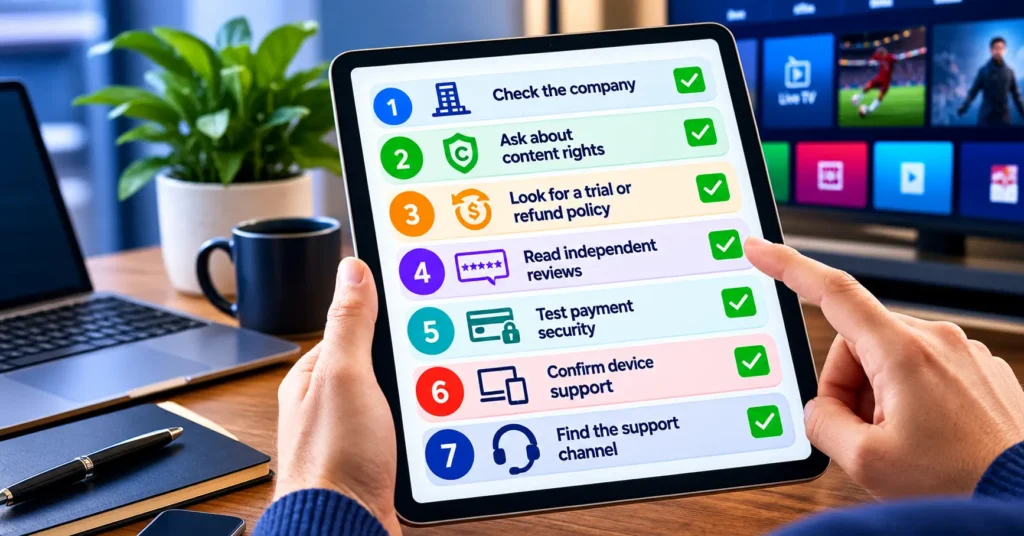
- Check the company. A registered business, a postal address and a named contact beat a username on a chat app every time.
- Ask about content rights. A genuine provider will tell you plainly which broadcasters or rights holders it works with.
- Look for a trial or refund policy. Short trials are normal. A “pay first, ask later” attitude is not.
- Read independent reviews. Look beyond the glowing testimonials on the seller’s own site.
- Test payment security. Cards and well-known processors give you recourse. Untraceable transfers give you none.
- Confirm device support. Smart TV, streaming stick, phone, set-top box: make sure yours is on the list.
- Find the support channel. Email, live chat or a ticket system is fine. A single messaging account is a worry.
Two of these deserve extra weight. Rights and payment security are the checks that separate a bad week from a lost year, so never skip them even if everything else looks lovely.
Notice what’s missing from that list? The cheapest price. I’ve never regretted skipping the lowest offer, but I have regretted chasing it.
Reading IPTV Packages Without Losing Your Mind
Packages are where the marketing gets creative, and it’s the stage where many people who buy premium IPTV lose their footing. You’ll see names like Ultra, Gold, Elite and Family, and none of them tells you what you actually get.
Ignore the labels and look at four things. Count the simultaneous streams, check the top picture quality, scan the channel categories, and see whether on-demand content is included. Everything else is decoration.
Simultaneous streams trip people up more than anything else. A plan with two streams sounds fine until the kids start watching in the bedroom while you’re watching downstairs. Count your household’s real viewing habits, not the optimistic version.
Below is a simple comparison of how typical IPTV packages are structured. Treat it as a template for your own notes, not as a price list.
| Package type | Best for | Typical streams | Watch out for |
|---|---|---|---|
| Basic | One person, casual viewing | 1 | Narrow channel range, lower quality |
| Standard | Couples and small households | 2 | Sport often costs extra |
| Family | Busy homes | 3 to 4 | Check that all streams work at once |
| Sports add-on | Fans of live events | Varies | Separate rights, separate bills |
| Annual plan | Committed viewers | Depends on tier | Refund terms matter far more |
Annual plans deserve a special mention. They look cheaper per month, but you’re trusting the provider for twelve months instead of one. When you buy premium IPTV on a long contract, start monthly first and commit only after you’ve lived with the service through a busy weekend of live sport.
For a deeper breakdown, see IPTV packages explained → / iptv packages . It covers tiers, contract lengths and the questions worth asking before you upgrade.
How to Spot a Premium IPTV Service That Isn’t
I’ve learned to read warning signs the way a mechanic listens to an engine. Something sounds off before you can say why. The best defence when you buy premium IPTV is a trained eye, and these are the red flags I see most often:
- Prices that are a fraction of what established services charge, with no explanation
- Promises of “every channel in the world” for pocket money
- Payment requests by gift card, crypto only, or transfer to a personal account
- No company name, no terms of service, no refund policy
- Pressure tactics such as “only three slots left today”
- Sudden rebrands and constantly changing website addresses
One or two of these might have an innocent explanation. Four or five together form a pattern, and the pattern says walk away.
Take a colleague of mine, who paid for a full year upfront because the seller offered a friends and family discount. Three weeks later the website was gone, and so was his money. He jokes about it now, though not very loudly.
A real premium IPTV service doesn’t need to shout. It publishes its terms, answers pre-sales questions patiently, and doesn’t mind you taking a day to decide.
Where the IPTV Reseller Model Fits In
Sooner or later you’ll meet an IPTV reseller. Sometimes it’s a small local business, sometimes it’s a friend of a friend with a spreadsheet. Resellers buy access or credits from a larger provider and sell subscriptions on to end users.
Plenty of legitimate businesses work this way, from mobile virtual network operators to software distributors. The model itself isn’t the problem. The problem is what’s being resold, and whether the upstream supplier has the rights to sell it.
That’s why a reseller deserves the same questions as any other seller. Who supplies the content, what happens if the supplier disappears, and will anybody refund you? Whether you buy premium IPTV directly or through a reseller, vague answers are your answer.
Anyone curious about the business side can read my separate piece: Becoming an IPTV Panel Reseller: What Nobody Tells You Before You Buy IPTV Credits → / iptv panel reseller. Read it before you spend a penny on credits, because the licensing questions apply to sellers just as much as to buyers.
Newcomers tempted to become an IPTV reseller should hear one more thing. Reselling content you don’t have the rights to isn’t a side hustle, it’s an invitation to civil and criminal action. Do it properly or not at all.
Quality, Latency, and Your Home Setup
Back to my brother-in-law for a moment. When we finally debugged his Saturday disaster, half the problem turned out to be his Wi-Fi, not the service.
Streaming is only as good as the weakest link between the provider and your sofa. These are the things I check before blaming anyone:
- Speed: roughly 5 to 10 Mbps per HD stream and about 25 Mbps for 4K
- Wired connection: Ethernet beats Wi-Fi for the main TV every time
- Router position: thick walls and fish tanks quietly wreck signals
- Device age: older sticks overheat and buffer
- Peak-hour testing: try your service at 8pm on a Friday, not 2pm on a Tuesday
Test first, blame later. A pricey plan can’t fix a flaky router.
Why Live Sport Lags
Latency deserves a mention too. Live sport over the internet usually runs a few seconds behind broadcast, sometimes more. That’s why your neighbour might cheer a goal before you see it.
Some services handle this better than others. Ask about it before you subscribe, particularly if live events are your main reason for signing up. No provider can promise zero delay, and you shouldn’t believe one that does.
How to Buy Premium IPTV Without Regret: A Practical Walkthrough
Right, let’s put it all together. This is the order I’d follow if you asked me to sit beside you while you buy premium IPTV for the first time.
- Decide your must-haves. Write down the channels, sports and devices you need before you look at a single price.
- Shortlist three providers. Apply the seven checks and drop anyone who fails two or more.
- Compare IPTV packages like for like. Same number of streams, same quality tier, same contract length.
- Start with a short term. A month or a trial is plenty to judge stability.
- Pay in a protected way. Cards and recognised processors give you somewhere to turn if things go wrong.
- Keep your records. Save the receipt, the terms and any support emails.
- Review after thirty days. Decide whether to renew, upgrade or leave.
None of that is glamorous. But people who follow a routine like this rarely end up writing angry reviews at midnight.
Making the Most of Your First Month
Think of the first month as a test drive. Treat it that way and you’ll learn more in four weeks than a hundred reviews could tell you.
Watch your usual shows in the evening, then try something unusual on a weekend. Sample live sport, a few on-demand films and any international channels you care about. If something is missing, you want to know now.
Contact support once, even if everything works. A quick technical or pre-sales question shows you how fast and how politely they reply. That tells you more than any testimonial.
Keep a simple note of every hiccup, with the date and time. If you need a refund or want to complain, specifics get results. “It was buffering a lot” rarely does.
Finally, check how your account behaves when you sign in on a second device. Some services limit connections strictly, and you’d rather discover that now than on the night of a big final.
The Trade-Offs Nobody Puts in the Advert
Every option has a downside, and pretending otherwise would be dishonest. Licensed premium services cost more than the rock-bottom alternatives, and live sport is sometimes locked behind separate subscriptions.
Contracts can be rigid. Channel lineups shift as rights deals change hands, and regional restrictions can frustrate expats who miss home or families following a team overseas.
On the other hand, you get stability, support, and the comfort of knowing your account won’t evaporate next month. I’d take that trade most days. It won’t suit everyone. Some households shouldn’t buy premium IPTV at all, and a free-to-air setup plus one paid app can be the more honest answer.
Picture two households. One pays a little more for a licensed service and watches happily for years. The other pays almost nothing, rebuilds the setup every few months, and spends weekends hunting for a new seller. Which of them is really saving money?
Before you commit, it’s worth reading independent advice. Which? publishes consumer guidance on streaming and smart devices, and Ofcom’s media research gives a useful picture of how Britain actually watches television.
A Last Word Before You Pay
I’ll leave you with the advice I gave my brother-in-law over one very long phone call. Don’t let the first price you see make the decision for you.
When you buy premium IPTV, you’re really buying reliability, support and a little trust. Spend your effort on those three things and the channel list mostly takes care of itself.
Now go and check that router. Then raise a glass to a Saturday night that doesn’t freeze with ten minutes to go.
Frequently Asked Questions
Is it safe to buy premium IPTV online?
It can be, provided you stick to licensed providers and protected payment methods. Check for a registered company, clear terms and a refund policy before you pay. Avoid sellers who insist on gift cards, crypto-only payments or transfers to personal accounts. If an offer sounds far too good to be true, it usually is.
How much should I expect to pay when I buy premium IPTV?
Prices vary widely depending on content, number of streams and contract length. Instead of hunting for the lowest figure, compare like for like: the same quality tier, the same channel types and the same number of devices. A very low price compared with established providers should make you ask what’s being cut. Monthly plans are the safest way to test a service before you commit.
What’s the difference between IPTV packages and a normal TV subscription?
A traditional subscription usually ties you to one provider, a set-top box and a long contract. IPTV packages deliver content over your broadband and often work across smart TVs, phones and streaming sticks. The trade-off is that your experience depends heavily on your internet connection. It’s also worth checking how many devices can stream at the same time.
Can I trust an IPTV reseller?
Some resellers are perfectly legitimate businesses, much like any distributor. The key questions are who supplies the content and whether that supplier holds the rights. A trustworthy IPTV reseller will answer plainly and put the terms in writing. If they dodge the questions, walk away.
What internet speed does a premium IPTV service need?
As a rough guide, plan for about 5 to 10 Mbps per HD stream and around 25 Mbps for 4K. Multiply that by the number of screens running at the same time. A wired connection to your main TV makes a noticeable difference. A good premium IPTV service will publish its own recommendations, so check them before you subscribe.