Don't miss our holiday offer - up to 50% OFF!

Premium IPTV Subscription Explained: Servers, Pricing and Real Support

Last winter I spent forty minutes on the phone with a friend in Coventry who was convinced his broadband had packed in. It hadn’t. His stream froze every evening at roughly eight o’clock, which happens to be the exact moment half the country sits down at once. His connection was fine. The service he’d paid for simply couldn’t cope with its own customers.
That’s the thing about a premium IPTV subscription. The word “premium” has been stapled onto so many checkout pages that it now tells you almost nothing about what you’re buying. It’s marketing wallpaper. The real answer to whether a service is worth your money sits in the infrastructure behind it, and almost nobody advertises that part because it’s boring and expensive.
So here’s the short version, before I spend three thousand words elaborating. Quality comes from server capacity, honest overselling limits, and an iptv service provider who treats support as a function rather than an inconvenience. Everything else is decoration.
I’ve been writing about streaming infrastructure for over a decade, and the pattern repeats with depressing reliability. Cheap goes wrong in January. Expensive sometimes goes wrong too. The difference is whether someone picks up when it does.
Why a premium IPTV subscription lives or dies on infrastructure
Picture a motorway with four lanes and a bank holiday. Doesn’t matter how new your car is; you’re going nowhere. Streaming platforms work the same way, except the lanes are server slots and the bank holiday is every weekday evening between seven and eleven.
A genuine premium IPTV subscription is built on load balancing across multiple points of presence, with failover that reroutes traffic when one node starts wheezing. The good operators run capacity headroom of thirty per cent or more. The poor ones sell until the servers scream.
Overselling: the quiet killer
Overselling isn’t inherently evil. Airlines do it. Hosting companies do it. The problem arrives when the ratio gets silly, because streaming doesn’t tolerate contention the way a web page does.
A web page loads in a burst and then leaves you alone. Video is a continuous demand on bandwidth for hours at a stretch. When a node is oversold by a factor of three, you get exactly what my friend in Coventry got: a perfect afternoon and a ruined evening.
Ask any provider what their concurrent-connection policy is. If the answer is vague, or if it’s a sales pitch about “unlimited” anything, you’ve learned something useful.
Bitrate, buffering and the honest truth about 4K
Everyone advertises 4K. Very few deliver it consistently, and fewer still deliver it at a bitrate that makes it worth having. A 4K stream running at 8 Mbps will look softer than a well-encoded 1080p stream at 6 Mbps, which is a fact the marketing copy conveniently skips.
Ookla’s Speedtest data has shown UK fixed broadband medians climbing steadily, but median speed isn’t the same as stable throughput during peak hours. Your line can be fast and still jitter. That’s where adaptive bitrate and buffer management earn their keep.
My rule of thumb after years of testing: judge a premium IPTV subscription by how it behaves at 9pm on a Saturday, never by how it behaves on a Tuesday morning. Anyone can look good on a Tuesday morning.
What separates a real iptv service provider from a landing page
Here’s a question worth sitting with. If a service disappeared tomorrow, would you have any way of knowing who you’d actually paid?
Plenty of storefronts are a template, a payment gateway and a Telegram handle. A serious iptv service provider looks different in ways you can verify in about ten minutes of digging. Registered company details somewhere on the site. A support channel that exists during declared hours. Documentation that predates last month.
The support test
Before buying anything, send a technical question. Not “do you have a trial,” which any bot can answer, but something specific: which EPG source they use, or how they handle failover during a node outage.
The reply tells you almost everything. A thoughtful answer within a few hours signals a team. A one-line “yes sir everything works” signals a reseller with no technical depth behind them. I’ve used this test for years and it has never once misled me.
A premium IPTV subscription from an operator with real engineering staff costs more because those salaries are real. That’s not a scam; that’s arithmetic.
Transparency signals worth checking
- Clear refund and trial terms written in full sentences, not three words in a footer
- A named business entity, ideally company-registered and findable
- Consistent uptime communication when something breaks, rather than silence
Notice what’s missing from that list. Logo walls, channel counts and stock photos of families on sofas tell you nothing. Industry publications such as Digital TV Europe have covered the fragmentation of the streaming delivery market at length, and the consistent theme is that operational maturity, not catalogue size, predicts survival.
Pricing, compared honestly
Let’s put numbers on the table, because vagueness helps nobody. The figures below reflect the broad market shape I see across the UK and EU, not any single vendor.
| Tier | Typical monthly cost | What you usually get | Where it breaks |
|---|---|---|---|
| Budget | £4 to £7 | Single server region, shared load, no SLA | Peak-hour freezing, vanishing support |
| Mid-range | £8 to £13 | Multi-node setup, basic EPG, ticket support | Inconsistent 4K, slow fault resolution |
| Premium | £14 to £25 | Redundant infrastructure, curated EPG, responsive support | Higher entry cost, still no legal shortcut |
| Reseller access | Priced in credits | Panel, sub-account control, margin | Requires your own support workload |
The gap between budget and premium is roughly the price of two coffees a month. I say that not to be glib but because people agonise over it, then lose an entire evening to buffering and consider that a fair trade.
Annual billing complicates things. A twelve-month premium IPTV subscription paid upfront is cheaper per month, but you’re betting on an operator staying solvent for a year. In this market that’s a genuine risk, and I’d take monthly billing at a slight premium until a provider has earned my trust.
Worth saying plainly: paying more guarantees nothing by itself. Price correlates with quality; it doesn’t create it.
The reseller side: iptv credits, panels and margins
Somewhere around the third or fourth conversation, most enthusiastic subscribers ask the same thing. Could I sell this?
Maybe. The economics are genuinely attractive and the operational reality is harder than people expect. Reselling turns you into a support desk, and support desks don’t sleep.
How iptv credits actually work
Most reseller systems run on a credit model rather than a cash-per-customer model. You purchase iptv credits in bulk, and each credit converts into a subscription period for one end user, typically one month, with longer terms costing multiple credits.
The appeal is straightforward. Buying iptv credits in larger blocks lowers your unit cost, so your margin widens as volume grows. A single credit might cost you a few pounds while the retail price you set sits two or three times higher.
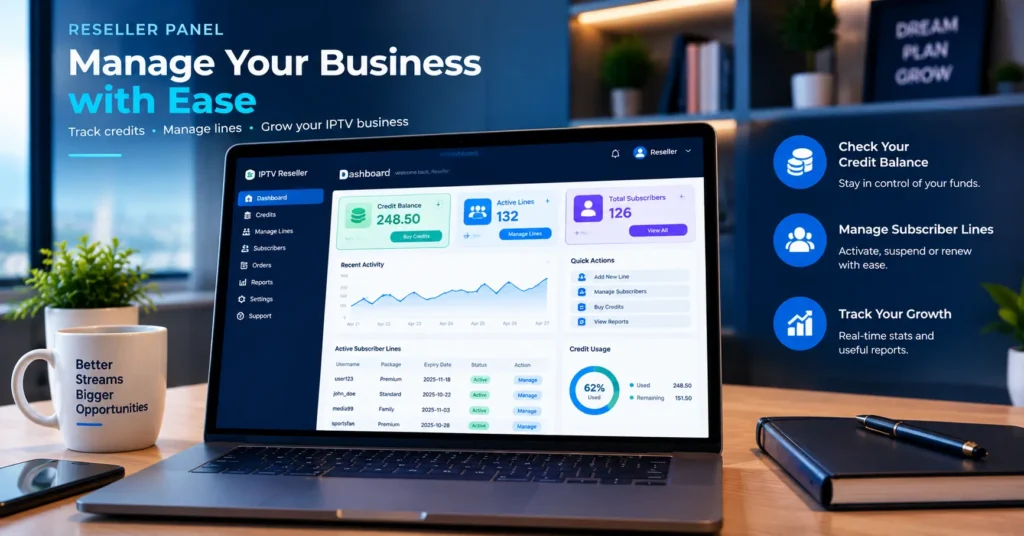
Credits also decouple your cash flow from your customer churn, which sounds abstract until it saves you. You’ve already paid for capacity, so a customer leaving mid-cycle doesn’t create a refund scramble with your upstream.
One caution from watching people do this badly: don’t buy twelve months of iptv credits on day one because the bulk discount looked lovely. Buy small, test the panel under real load, then scale.
Before you buy iptv reseller panel access
If you’ve decided to buy iptv reseller panel access, the panel itself deserves more scrutiny than the price. You’ll live inside that interface daily, and a clumsy one will cost you hours every week.
Check whether the panel supports sub-resellers, because that’s how you scale beyond your own selling hours. Check whether you can generate lines, extend them and troubleshoot connections without emailing anyone. Check whether usage logs are visible to you, since that’s your only defence against credential sharing.
The decision to buy iptv reseller panel access is really a decision about who your upstream partner is. Panels are software; partners are the thing that determines whether you have a business in six months. Ask about their escalation path before you ask about their discount tiers.
And be realistic about time. A reseller running two hundred lines is handling setup questions, device compatibility and billing chases most evenings. That’s a second job, not passive income.
Abonnement IPTV: What You Need to Know Before You Subscribe → / abonnement iptv
The legal part nobody wants to read
I’d be doing you a disservice if I skipped this, so let’s be direct. Streaming delivery technology is entirely legal. What travels through it may not be.
Ofcom and rights holders across the UK and EU have been increasingly active on unlicensed redistribution, and enforcement has shifted from end users toward operators and facilitators. The BBC has reported on multiple prosecutions of unlicensed operators in recent years, and the trend is one direction only.
So what does that mean for you practically? It means asking any iptv service provider about licensing and content rights, and treating an evasive answer as an answer. It means understanding that a premium IPTV subscription offering everything ever broadcast, worldwide, for eight pounds, is telling you something about its rights position without meaning to.
For resellers the exposure is greater, because you’re the visible party. Whatever you build, build it on a supply chain you can explain to someone in a suit.
Setting up your premium IPTV subscription without the headaches
Right, practical section. Assume you’ve bought, you’ve got credentials, and you want it working before the evening.
- Start with a wired connection for your first test, even if you’ll use Wi-Fi later. This isolates variables and tells you whether the problem is the service or your network.
- Choose a player that suits your hardware rather than the one a forum recommended. Android TV boxes, Fire sticks and smart TVs all behave differently, and the same premium IPTV subscription can feel sluggish on one and flawless on another.
- Load the EPG separately and give it time. Guide data often takes several minutes to populate on first run, and people panic at minute two.
- Test at peak hours before the trial window closes. Anything else is a wasted trial.
- Document your credentials somewhere sensible. You’d be amazed how many support tickets are just people who’ve lost their login.
If step four goes badly, don’t spend a week troubleshooting. Peak-hour instability on day one rarely improves, because the underlying cause is capacity and capacity doesn’t fix itself quietly.
Router settings that actually matter
Most home network advice on this subject is folklore. Two things genuinely help: enabling QoS so video traffic gets priority over background downloads, and moving to the 5 GHz band if you’re within reasonable range of the router.
DNS changes get recommended constantly and help far less often than claimed. Try them by all means, but don’t expect miracles from changing four numbers.
When a premium IPTV subscription is the wrong buy
Not everything suits everyone, and I’d rather lose your click than your trust. There are situations where a premium IPTV subscription simply isn’t the sensible purchase.
If your household watches four hours a week and already holds two mainstream on-demand services, you’re buying capacity you’ll never use. If your broadband delivers under 15 Mbps during evening hours, no provider on earth will make that comfortable. Fix the line first.
If you need guaranteed availability for a commercial setting, a pub or a hotel for instance, the requirement changes entirely. Commercial use carries licensing obligations that consumer services don’t cover, and treating a consumer premium IPTV subscription as a business solution is a mistake that ends expensively.
And if you’re technically uncomfortable and have nobody to call, weigh that honestly. The convenience gap between a managed mainstream platform and a self-configured setup is real.
A short checklist before you pay
- Trial tested during peak hours, not off-peak
- Provider answered a technical question with technical substance
- Billing terms and refund policy readable in plain English
- Payment method offering some recourse if things go wrong
- A clear, human support channel with stated hours
That’s five items and it takes about an afternoon. Given that a premium IPTV subscription is a recurring commitment, an afternoon is cheap diligence.
One last piece of editorial honesty. I’ve tested services that were superb for eight months and then degraded sharply after a capacity change upstream. No checklist protects you permanently, which is why I favour monthly terms and keep my expectations proportionate to what I’m paying.
Frequently Asked Questions
How much should a premium IPTV subscription cost per month?
Expect to pay somewhere between £14 and £25 monthly for a service with genuine redundancy, curated guide data and responsive support. Anything under £7 is almost certainly running on oversold infrastructure, because the arithmetic of server capacity doesn’t permit it otherwise. Annual plans reduce the monthly figure but transfer risk to you if the operator disappears. I’d rather pay slightly more per month and keep the freedom to walk away.
Is a premium IPTV subscription legal in the UK?
The technology itself is entirely legal and widely used by licensed broadcasters and telecoms firms. Legality depends on whether the content being delivered is properly licensed for your territory. Services offering vast international catalogues at very low prices are usually operating without those rights. Ask your provider directly about licensing, and treat vagueness as a red flag rather than a formality.
What are iptv credits and do I need them as a normal viewer?
Credits are the internal currency of reseller panels, where one credit typically converts into one month of service for one end user. As an ordinary viewer you’ll never touch them, since you’re simply paying a retail price. They matter only if you intend to resell, in which case buying iptv credits in volume is how your margin is built. Most panels offer tiered pricing where larger purchases reduce the per-credit cost.
Should I buy iptv reseller panel access as a side business?
It can work, but treat it as a service business rather than passive income. When you buy iptv reseller panel access you’re taking on customer support, device troubleshooting and billing management, which realistically consumes several hours a week once you pass fifty customers. Start with a small credit block, test the panel under genuine load, and scale only after you’ve proved your support workflow. The people who fail at this almost always over-purchase before they’ve served a single customer.
How do I know whether an iptv service provider is trustworthy?
Look for a findable business entity, documentation that predates the current month, and support that answers technical questions with technical answers. Send a specific question before you buy and judge the response quality rather than the response speed alone. Check whether their terms are written in full sentences, since sloppy legal copy usually signals sloppy operations. Community discussion helps, though bear in mind that review sites in this sector are heavily gamed.
A final thought
Streaming delivery is maturing, slowly and unevenly, and the operators who survive the next few years will be the ones who invested in capacity rather than copywriting. That shift favours you as a buyer, provided you know which questions to ask.
Run the peak-hour test. Send the awkward technical email. Pay monthly until someone earns your year. Do those three things and you’ll end up with a service that simply works, which is all any of us wanted in the first place.