Don't miss our holiday offer - up to 50% OFF!


Buy IPTV Panel Credits With Confidence: Start Reselling Today

A reseller I’ve known for years rang me on a Sunday evening, furious. He’d paid a supplier three hundred pounds on the Friday, received a login, and by Sunday morning the panel URL returned nothing at all. No reply on Telegram. No refund. Just silence and forty customers wondering why their service had stopped.
That call is the reason I keep writing about this subject. If you’re about to buy IPTV panel access, the single most useful thing I can tell you is that the software is rarely the problem. The people behind it are. Get the supplier wrong and no feature list on earth will save you.
What You’re Really Buying When You Buy IPTV Panel Access
Let’s be precise, because vague language is how bad deals get sold. A panel is a management dashboard. It lets you create user accounts, assign durations, set connection limits, monitor who’s online, and hand out credentials to your own customers under your own branding.
What it isn’t is a magic box that conjures a working service out of nothing. The panel sits on top of infrastructure: servers, bandwidth, load balancers, restreaming capacity. When you buy IPTV panel credits from a provider, you’re really buying a slice of that infrastructure plus a friendly interface to control it.
I’ve seen sellers blur this deliberately. They’ll show you a glossy dashboard screenshot and say nothing about where the actual delivery happens. Ask. Always ask.
The distinction matters for a practical reason. Dashboards are cheap to clone. Stable delivery infrastructure is expensive to run, and that cost is the honest floor under any price you’re quoted.
The Credit System, Stripped of Its Jargon
Almost every serious iptv reseller operation runs on credits. One credit typically equals one month of service for one customer line, though the ratio varies by provider and by package tier.
So a hundred credits might mean a hundred customers for one month, or eight customers for a year, or any combination in between. You spend credits as you create or renew lines. When you run low, you top up.
Why do suppliers structure it this way rather than charging a flat monthly fee? Because credits align their revenue with your growth instead of your promises. You only pay for what you actually sell, which is genuinely fairer to a new reseller than a fixed subscription that punishes a slow month.
There’s a catch worth knowing. Credits at most providers don’t expire, but panels do get retired, migrated, or rebranded. I’ve watched resellers hold thousands of unspent credits on a platform that changed hands and honoured none of them.
My rule, after years of watching this pattern repeat: buy enough credits to cover your realistic next ninety days, and no more. Bulk discounts are seductive. Illiquid balances are not.
Before You Buy IPTV Panel Credits, Run These Seven Checks
This is the part I’d hand to anyone starting out. None of it is complicated, and all of it takes less than a day.
- Request a test line first. Any supplier confident in their delivery will give you a short trial without argument. Hesitation here tells you everything.
- Test during peak hours. Between roughly 7pm and 11pm local time on a weekend is when infrastructure either holds or falls apart. Midday testing proves nothing.
- Check the panel’s own uptime, not just the streams. Your customers can tolerate a stream hiccup. You cannot tolerate being locked out of your own dashboard on renewal day.
- Ask directly how support is staffed. Is it one person on a phone, or a rota? Ask what happens at 2am. The answer, or the dodge, is informative.
- Look for a sub-reseller function. If you ever want to build a small network under you, that feature needs to exist before you need it, not after.
- Confirm the billing and renewal flow. Some panels handle expiry notifications natively. Others leave you tracking dates in a spreadsheet, which is fine at twenty customers and miserable at two hundred.
- Read their terms on account portability. If you decide to leave, what happens to your customer list? Most answers are unsatisfying, but the honest ones say so plainly.
Work through those seven and you’ve already filtered out perhaps eighty percent of the suppliers who’d have wasted your money. I’d rather you spend a week on diligence than a quarter on regret.
Where First Month Resellers Quietly Lose Money
Here’s something nobody puts in a sales page. The costliest mistakes in month one aren’t technical at all. They’re commercial.
New resellers undercharge, almost universally. They look at a competitor’s headline price, shave twenty percent off it, and build a customer base that generates barely enough margin to cover the credits. Then support requests arrive, and every hour spent troubleshooting eats the thin profit that was already there.
I did this myself in my first venture, years ago. I priced at a level that felt generous and ended up working evenings for what amounted to about four pounds an hour. The customers were happy. I was exhausted and no richer.
The second trap is over-promising on device support. A customer with an ageing smart TV and a flaky router will blame you for everything, and no amount of panel quality changes that. Set expectations in writing before you take payment.
The third is neglecting churn maths. If you’re losing fifteen percent of customers monthly, you need to acquire fifteen percent just to stand still. That’s a treadmill, and it’s why retention beats acquisition almost every time.
Ofcom’s ongoing research into UK media habits has repeatedly found that households now juggle multiple subscription services and cancel them with very little friction. That behaviour applies to you too. Low switching cost cuts both ways.
Buy IPTV Reseller Panel the Smart Way: A Practical Guide → / buy iptv reseller panel
Panel Tiers Compared at a Glance
Suppliers rarely lay out their tiers side by side, so I’ve built a rough composite of what the market typically offers. Treat the figures as indicative rather than a quote.
| Tier | Typical Entry Credits | Sub-Reseller Access | Support Response | Best Suited To |
|---|---|---|---|---|
| Starter | 10 to 25 | Usually none | 12 to 24 hours | Testing the waters, first ten customers |
| Standard | 50 to 100 | Sometimes, limited | 2 to 8 hours | An iptv reseller with steady local demand |
| Advanced | 250 to 500 | Yes, multi-level | Under 2 hours | Established operators scaling a base |
| White Label | 1000+ | Full, with branding | Priority, often direct | Agencies running their own identity |
Notice what changes as you move down that table. It isn’t really the feature set. It’s the speed at which a human being answers you when something breaks.
That’s the thing I’d pay a premium for every single time. Features are static. Support is the variable that determines whether a bad night becomes a lost customer.
Owning a Panel Versus Flipping Someone Else’s Subscriptions
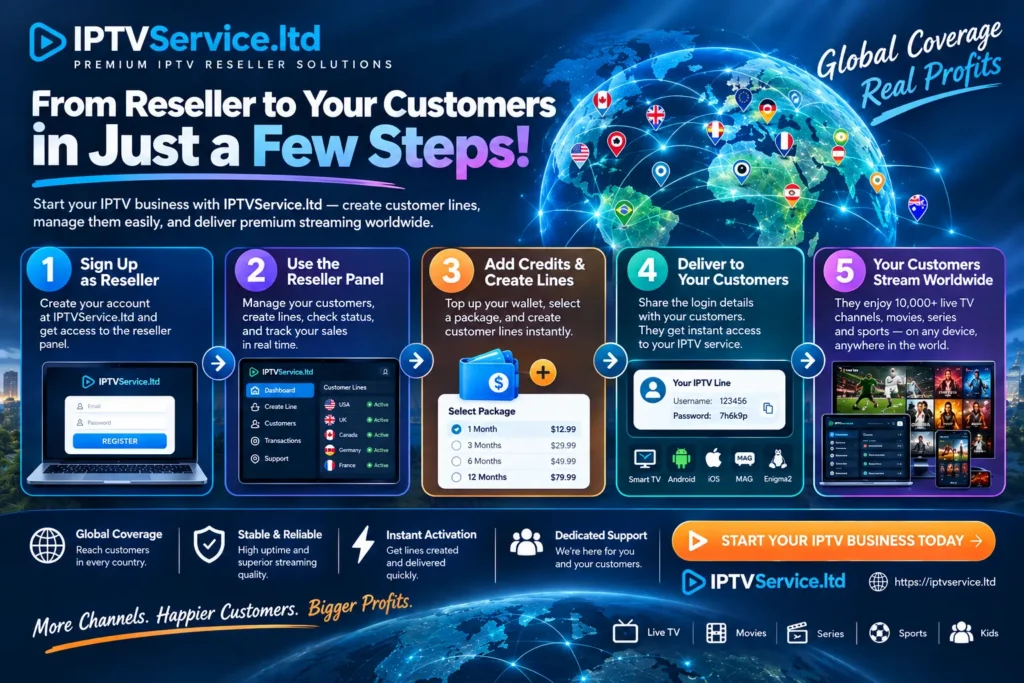
There are two routes into this business and they suit very different temperaments. One is to simply resell individual subscriptions, buying access and passing it on with a markup. The other is to buy IPTV panel credits and manage your own line creation end to end.
Flipping subscriptions is lighter. No dashboard to learn, minimal setup, and you can start this afternoon. The margins are thinner, you have no control over line management, and you’re entirely dependent on your source’s goodwill.
Running a panel is heavier and better. You control durations, connection limits, and renewals. You can build your own branding. You can see, in real time, who’s actually online and who’s about to churn.
Which one should you pick? If you expect to stay under ten customers as a side earner, the lighter route is honestly fine. If you’re aiming at fifty or more, buy IPTV panel access early, because migrating a customer base later is genuinely painful.
I’ll add a caveat that sellers won’t. Panel ownership adds administrative weight. If you hate dashboards, hate record-keeping, and want zero operational responsibility, this model will frustrate you regardless of how good the provider is.
The Unglamorous Things That Decide Everything
Bandwidth headroom. Nobody markets it, everybody depends on it. Sandvine’s Global Internet Phenomena reports have documented for years how video traffic dominates network load, and that pressure concentrates at exactly the hours your customers want to watch.
A provider running close to capacity looks identical to a provider with generous headroom, right up until a busy evening. Then the difference is obvious and your inbox tells you about it.
Panel response time is the second unglamorous metric. If the dashboard takes eleven seconds to load a user list, that friction compounds across every renewal you process. Small delays feel trivial until you’re doing them two hundred times a month.
Then there’s documentation. A supplier with a proper knowledge base has thought about your problems before you had them. A supplier who answers everything ad hoc over chat has not, and you’ll feel the gap when they’re asleep.
Finally, billing transparency. I want an invoice, a credit balance I can verify, and a record of every transaction. Anything less is a relationship built on trust alone, and trust is a poor substitute for an audit trail.
What Fair Pricing Actually Looks Like
Let’s talk numbers honestly, because the vagueness in this market is deliberate and unhelpful. Credit costs fall as volume rises, which is normal. The question is whether the floor price makes any sense.
If a supplier offers credits at a price that couldn’t conceivably cover server and bandwidth costs, something is wrong with the model. Either the infrastructure is oversubscribed, or the business is being funded by new signups rather than operations. Both end the same way.
Equally, an inflated price with no corresponding service level is just margin extraction. You’re entitled to ask what the premium buys. If the answer is fluff, walk.
My working benchmark: when you buy IPTV panel credits, the cost per line per month should leave you a gross margin of at least fifty percent at a competitive retail price. Below that and support workload will erode your profit into nothing.
Consider a scenario. You sell at ten pounds a month, your credit costs three, and you keep seven. Handle a hundred customers and that’s seven hundred gross, before your time and any refunds. Now run the same maths at a six pound credit cost and the business barely justifies the effort.
That’s the calculation people skip. Do it before you commit, not after.
Who This Model Genuinely Doesn’t Suit
I’d be doing you a disservice if I painted this as universally suitable. It isn’t.
If you have no existing audience, no local network, and no appetite for customer service, reselling will feel like pushing a boulder. Customers don’t arrive because you bought a panel. They arrive because someone trusts you enough to hand over money for something they could theoretically find elsewhere.
There’s also a compliance dimension that varies considerably by jurisdiction. Understanding what you’re permitted to distribute, and under what licensing arrangements, is your responsibility and not your supplier’s. Take that seriously and get local advice if you’re unsure.
And if you’re chasing a passive income fantasy, this isn’t it. It’s a small operations business with real obligations to real people.
A Parting Thought Before You Commit
The reseller who rang me that Sunday evening did recover. He rebuilt on a different platform, took his time with the supplier vetting, and now runs a steady operation with a couple of hundred lines. When I asked what he’d do differently, he said he’d have spent a fortnight on diligence instead of an afternoon.
That’s the whole lesson, really. The decision to buy IPTV panel access is not urgent, however much a sales chat tries to make it feel that way. Limited-time pricing is a pressure tactic, and pressure tactics are how careless purchases happen.
Take the test line. Test it at peak. Ask the awkward questions about support staffing and portability. Then, and only then, buy IPTV panel credits in a quantity that matches your next quarter rather than your ambitions.
Do that, and you’ll be starting from a position most new resellers never reach. The market rewards patience far more than it rewards speed, and the operators still standing in three years will be the ones who chose their foundation carefully.
Frequently Asked Questions
How much does it cost to buy IPTV panel access as a beginner?
Entry level packages typically start with a small credit bundle, often between ten and twenty five credits, which is enough to service your first handful of customers. Prices vary considerably between suppliers depending on infrastructure quality and support level. I’d suggest budgeting for a starter bundle you can afford to write off entirely, because your first supplier may not be your final one. Treat the initial purchase as paid research rather than a long term commitment.
What’s the difference between a panel and the best IPTV subscription for a single household?
A subscription serves one household with a fixed set of credentials and no management tools. A panel is a business tool that lets you create and administer many lines under your own control. Someone searching for the best IPTV subscription is a consumer; someone buying a panel is an operator. The two products serve completely different purposes, and confusing them is a common mistake among newcomers.
Do I need technical skills to buy IPTV panel credits and run the dashboard?
Not really, though basic comfort with web interfaces helps enormously. Most modern panels are point and click, with straightforward forms for creating lines and setting expiry dates. What you will need is patience for customer side troubleshooting, since the majority of complaints trace back to a customer’s device, app, or home network rather than the panel itself. Good suppliers provide documentation that covers the common scenarios.
How do I judge whether a supplier offers the best IPTV service quality?
Test during peak evening hours over at least several days rather than making a snap judgement from a single session. Watch for buffering patterns, channel load times, and how quickly the panel itself responds. Claims about being the best IPTV service are marketing language and mean nothing on their own. Real evidence comes from your own testing and from talking to other resellers who have used the platform for six months or more.
Can I switch suppliers later without losing my customers?
Technically yes, but the process is disruptive and you should plan for it rather than improvise. Your customers hold credentials tied to your current provider, so a migration means reissuing every line and asking each person to update their setup. Expect some churn during the transition, realistically somewhere between five and fifteen percent. This is precisely why the initial supplier choice deserves proper scrutiny.