Don't miss our holiday offer - up to 50% OFF!

What Are IPTV Credits, Exactly?

Picture this: it’s a Sunday afternoon, and you’ve just convinced four members of your household to ditch the satellite dish. Someone’s done the maths. You’re spending the better part of £80 a month across two streaming subscriptions and a legacy TV package, and the honest truth is that nobody’s watching half of it. So you start researching IPTV.
Within about twenty minutes, you’ll encounter IPTV credits and if your experience is anything like mine, you’ll find the terminology slightly baffling at first.
The IPTV credit system is a prepaid unit-based payment model used by many Internet Protocol Television providers. Rather than charging a flat recurring fee each month, some services issue IPTV reseller credits that you purchase upfront. Those credits are then drawn down as you access content, add connections, or extend your subscription period. Think of them roughly like pay-as-you-go mobile data, applied to television.
The model isn’t universal. Some IPTV providers operate on pure monthly billing, while others have built entire ecosystems around IPTV credits as the primary transactional currency. Knowing which model you’re dealing with before you commit is genuinely important.
How the Credit System Actually Works
Most credit-based IPTV platforms operate on a reseller hierarchy. A central provider issues IPTV credits in bulk to resellers. Businesses looking to buy IPTV credits can then purchase them through approved distributors or master panels, who then distribute or sell them to end users. Each credit typically maps to a unit of access often a single connection for a set time period (commonly one month, three months, six months, or twelve months).
Here’s a simplified breakdown of how IPTV panel credits typically flow through the chain:
- Master panel operators purchase credits in bulk, usually at the lowest per-credit cost.
- Sub-resellers buy from master operators and mark up modestly.
- End users receive their subscription via a reseller, who draws credits from their panel to activate the service.
- Credit consumption happens at the point of activation or renewal, not on a per-channel or per-stream basis in most implementations.
The practical upshot? If you’re buying from a reseller, the price you pay reflects wherever that reseller sits in the chain. You can often work out a rough idea of the margin involved by comparing the per-credit cost quoted to you against industry forum discussions on sites like Reddit’s r/IPTV community or the Digital Spy forums, both of which have fairly active threads on pricing benchmarks.
One thing worth understanding early: credits don’t expire in the same way that, say, a mobile top-up might. The expiry is typically tied to the subscription period they activate, not to a calendar countdown from purchase. That distinction matters when you’re planning how many credits to buy at once.
The Hidden Costs Nobody Warns You About
Right, let’s be honest about this part, because too many guides gloss over it.
IPTV credits sound clean and simple and structurally, they are. But there are layered costs that can erode the value quite quickly if you’re not paying attention.
Multi-connection pricing is the big one. Most credit systems are priced per connection, per period. If your household wants two simultaneous streams (one in the living room, one in the bedroom), you’re looking at double the credit spend. Some providers offer multi-connection bundles, but you often have to ask, and the discounts aren’t always prominently advertised.
Reseller mark-ups vary wildly. I’ve seen the same underlying credit value quoted at nearly three times the price by different resellers operating in the same market. The service quality underneath may be identical. Doing a bit of comparative shopping through established IPTV communities is worth the twenty minutes it takes.
Trial credits are sometimes non-transferable. Some platforms offer trial or “tester” credits with restrictions. They won’t roll into a full plan, they might expire faster, or they might only unlock a subset of channels. Read what you’re getting before you hand anything over.
There’s also the question of service reliability. Unlike a regulated broadcast package from a company like Sky or Virgin Media, IPTV credit providers have no mandated uptime obligations. If a service goes down and your credits are sitting unused, what recourse do you have? That’s a conversation worth having with your provider before you commit to a large credit purchase.
Choosing a Provider: What the Reviews Don’t Tell You
Most review sites in this space are, to put it gently, not written with full independence. Affiliate arrangements are common, and a “Best IPTV Services of the Year” list is rarely free of commercial bias. That’s not a dig at every reviewer it’s just the reality of a market operating in legal grey areas in many jurisdictions.
What should actually inform your choice?
Channel Count Is Not Quality
A provider advertising 20,000 channels is not automatically superior to one offering 8,000. In practice, channel count often inflates through duplicate regional feeds, foreign-language streams of questionable utility, and test channels. What matters more is the quality and stability of the specific channels you’ll actually watch.
Ask yourself: are the UK’s main HD channels (BBC One, ITV, Channel 4, Sky Sports, BT Sport equivalents) reliably available? Are they offered in genuine HD, not upscaled SD? Is there a catch-up or VOD library, and is it actually maintained?
EPG Reliability Is Underrated
The Electronic Programme Guide on an IPTV service can make or break daily usability. A well-maintained EPG that shows accurate scheduling information, with reliable metadata, is often a better signal of provider quality than headline channel counts. When trialling a service, spend time in the EPG rather than just channel-surfing.
Support Response Time Tells You a Lot
Send a support query before you buy. Note how long it takes to get a response, and whether the response actually addresses your question. Some providers reply in minutes; others take days. Given that IPTV credits are often purchased for access-critical periods (a football season, say), slow support can become a real problem.
best IPTV providers UK → /best iptv provider/]
How to Maximize Your IPTV Credits Without Wasting a Single Penny
Here’s the practical part. Seven approaches that genuinely make a difference.
1. Buy in Bulk But Only Once You’re Confident
The per-credit cost drops meaningfully at higher volumes with most providers. A 12-month credit purchase might cost 30 to 40 percent less per month than buying in single-month increments. But you should only go long once you’ve properly tested the service. A month or two of reliable performance is the minimum before committing to a large IPTV credits outlay.
2. Share a Multi-Connection Plan
If you have a partner, flat mate, or family member who’d also benefit from the service, a shared two-connection credit plan is usually far cheaper per user than two separate subscriptions. The maths here is almost always in your favour. Just confirm that the provider’s terms allow multi-device use across a household.
3. Time Your Purchases Around Promotions
IPTV credit promotions tend to cluster around major sporting events (the start of a football season, for instance) and around Black Friday. If you can anticipate when you’ll want to renew, you can often wait two or three weeks to catch a credit bonus or discounted rate.
4. Use Trial Credits Properly
Don’t just flick through channels during a trial. Use it to stress-test exactly what you care about: does the service buffer during peak viewing hours (7 to 10 pm)? Does the EPG update properly? Does the VOD library load reliably? A structured trial tells you far more than a casual browse.
5. Negotiate with Your Reseller
This one surprises people, but many IPTV reseller have enough margin flexibility to offer a deal if you’re buying multiple connections or committing to a longer term. It doesn’t hurt to ask. The worst that happens is you pay the listed price.
6. Monitor Your Credit Balance Proactively
Some platforms let credits run down without much warning. If your subscription lapses unexpectedly, you might miss a crucial match or live event. Set a personal reminder a week before your credits are due to run out. Some providers also offer auto-renewal if your balance is sufficient, which removes the risk entirely.
7. Avoid Top-Up Traps
Some resellers offer “credit top-up” deals that sound generous but reset your subscription clock rather than extending it from the current end date. That means you could accidentally lose days off your existing subscription. Always confirm exactly how a top-up is applied before purchasing additional IPTV credits.
IPTV Credits vs. Traditional Subscription Models
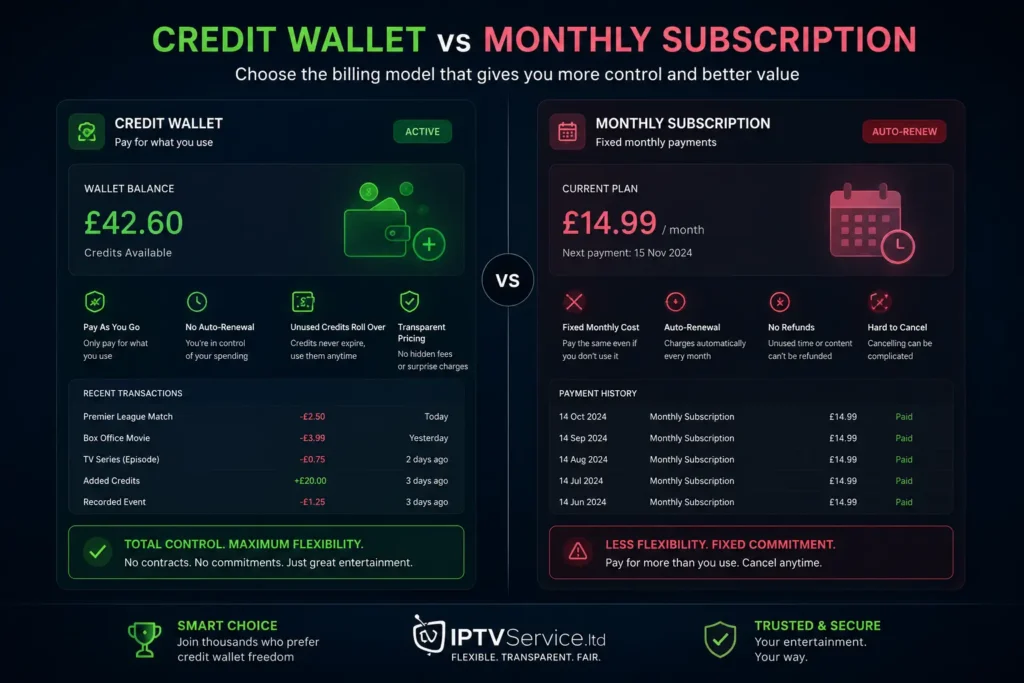
It’s worth stepping back and comparing the two approaches directly, because the right answer genuinely depends on how you watch.
| Factor | IPTV Credits | Traditional Monthly Sub |
|---|---|---|
| Upfront cost | Higher (bulk purchase) | Lower |
| Long-term value | Often better | Depends on provider |
| Flexibility | Medium (tied to activation) | High (cancel anytime) |
| Transparent pricing | Variable | Usually clearer |
| Reseller availability | Wide | Direct only |
| Regulatory protection | Minimal | Higher (licensed services) |
The credit model tends to suit viewers who know what they want, plan ahead, and are comfortable operating outside the traditional broadcasting ecosystem. The monthly subscription model suits viewers who value flexibility and predictable billing. If you’re comparing providers, our guide to the best IPTV subscription options explains the key differences in pricing, reliability, features, and consumer protections.
Is one objectively better? No. They serve different kinds of viewers. Anyone telling you otherwise is probably trying to sell you something.
When Credits Don’t Make Sense for You
IPTV credits aren’t the right fit for everyone, and I’d rather say that clearly than pretend otherwise.
If you watch television only occasionally, a pay-per-view or on-demand model from a licensed provider like Apple TV+ or Amazon Prime Video will almost certainly serve you better. The value of IPTV credits only emerges through consistent, regular use across a meaningful channel selection.
Similarly, if you depend heavily on real-time customer support, automatic consumer rights protections, or guaranteed uptime, a regulated provider is the safer choice. The IPTV credit ecosystem is largely unregulated, and recourse when things go wrong can be limited or nonexistent.
There’s also the legal dimension, which varies by country and provider. Not all IPTV services operate with the appropriate licensing for the content they carry. The credit-based model in particular is often associated with unlicensed content distribution. If that’s a concern for you and it should be, at least as an informed consideration then research your chosen provider carefully before committing IPTV credits to any plan.
A piece in Torrent Freak from 2023 documented how enforcement action against unlicensed IPTV providers has intensified across Europe and North America. That’s worth factoring into any long-term reliance on a credit-based service from a provider without transparent licensing information.
Frequently Asked Questions
Q1: What are IPTV credits and how do they work?
IPTV credits are a prepaid currency used by many Internet Protocol Television providers to manage access to their streaming services. When you purchase credits, they’re stored in your account or a reseller panel, and drawn down when you activate a subscription or add connections. One credit typically corresponds to one connection for one defined time period. The system is designed primarily for resellers managing multiple customers, but end users can also buy and manage credits directly with some providers.
Q2: How many IPTV credits do I need for a typical household subscription?
It depends on the number of simultaneous connections your household requires and the subscription period you want to activate. Most providers charge one credit per connection per month, so a two-connection household watching for six months would need twelve credits at minimum. Some providers bundle multi-connection discounts, which reduces the total IPTV credits required. Always confirm the exact credit cost per connection and period with your provider before purchasing.
Q3: Can I get a refund if I’m unhappy with my IPTV service after using credits?
Refund policies vary widely across providers, and many explicitly state that credits are non-refundable once used to activate a subscription. This is one reason why properly testing a service during a trial period is so important before making a large IPTV credits purchase. If you encounter a provider that refuses any form of refund for unused or barely-used credits, that’s a red flag worth noting before you commit to a significant spend.
Q4: Are IPTV credits legal to buy and use?
Purchasing credits themselves is generally not illegal, but the legality of what those credits unlock depends entirely on whether the underlying IPTV provider holds the appropriate content licences for your region. Some providers operate with full licensing; many do not. Consumers in the UK should be aware that accessing unlicensed broadcast content may carry legal risk, and the issue is taken seriously by organizations like the Premier League and major broadcasters. Always research the licensing status of any provider before committing.
Q5: What’s the best way to store and manage IPTV credits if I buy in bulk?
Most providers or reseller panels offer a dashboard where your IPTV credits are displayed in real time. Keep a note of your current balance and the expiry terms associated with your credits (whether they expire independently of activations or only when used). Some resellers allow credit transfers between sub-accounts, which is useful if you’re managing multiple subscriptions. Set calendar reminders well ahead of renewal dates, and confirm with your reseller how top-ups interact with your existing balance.