Don't miss our holiday offer - up to 50% OFF!


Why the UK IPTV Reseller Market Is Worth Understanding

Picture this: it’s a Sunday afternoon, someone messages you asking whether you offer a sports package. You check your reseller panel, activate their trial in under two minutes, and they’re watching the match before the first whistle. That’s the appeal of being a best IPTV reseller UK in a nutshell. Low overhead, fast setup, recurring revenue.
The UK streaming market has grown rapidly over the past decade. According to Ofcom’s annual communications market report, the majority of UK households now subscribe to at least one video-on-demand service. But official platforms like Netflix, Disney+, and Sky don’t capture the entire appetite for content, particularly live sports. That gap is where the UK IPTV reseller sits, for better or worse.
IPTV, for those still getting their bearings, stands for Internet Protocol Television. It delivers television content over the internet rather than through satellite or cable. As a reseller, you’re not building the infrastructure yourself. You purchase credits or a panel from a wholesale provider and sell subscription access to end users.
It sounds simple. And in some ways, it is. But there’s real complexity underneath.
The Legal Landscape: What Every UK Reseller Must Know
Here’s the question that most people typing “how to become a UK IPTV reseller” into Google aren’t prepared to confront directly: is this legal?
The honest answer is that it depends almost entirely on the content being streamed. There’s a clear and important distinction between licensed IPTV services and unlicensed ones. Legitimate, fully licensed IPTV services do exist. Companies like BT TV, Virgin Media, and various smaller operators hold the appropriate broadcasting licences and content rights. Reselling access to those kinds of services, where the business model supports it, can be entirely lawful.
The problem is that the vast majority of cheap panel-based IPTV services being sold across Telegram groups and forums are not licensed. They aggregate live channels, premium sport, and on-demand content without paying rights holders. Selling iptv best subscription to these services puts you in the territory of copyright infringement under the Copyright, Designs and Patents Act 1988.
The Premier League and other rights holders have become increasingly aggressive in pursuing enforcement actions. The Federation Against Copyright Theft (FACT) and the Police Intellectual Property Crime Unit (PIPCU) have both conducted operations targeting UK-based resellers. This isn’t theoretical. Real prosecutions have occurred.
I’ll be direct with you: if you’re planning to build a business on unlicensed streams, this guide won’t encourage you to do that. What it will do is give you a full, honest picture of how this market operates, who thrives, who gets burned, and what the smarter alternative paths look like.
How to Choose the Right IPTV Panel Provider
If you are working within a legitimate licensed model, or you’re doing your research before making any decisions, understanding how provider panels work is genuinely useful knowledge.
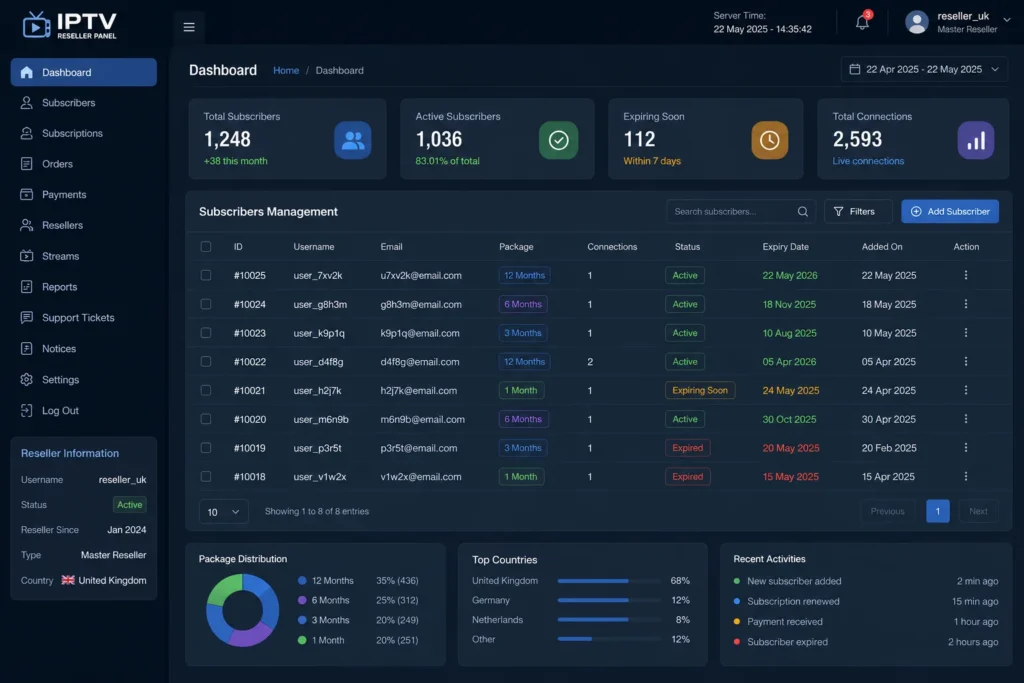
A reseller panel is the backend dashboard through which you manage your customers’ subscriptions. You buy credits in bulk from a wholesaler. Each credit typically represents one month of access for one user. You then set your own retail price and sell individual subscriptions.
What separates a decent provider from a frustrating one? Here’s what to look at.
Uptime reliability. If the streams go down every weekend during peak sport viewing times, your customers won’t stay. Ask any established UK IPTV reseller and they’ll tell you: uptime is non-negotiable. Anything below 99% uptime is a liability.
Server redundancy. Solid providers run multiple server clusters across different data centres. If one goes down, traffic routes elsewhere automatically. Single-server providers are risky for obvious reasons.
Channel count versus channel quality. Some panels advertise 20,000 channels. Many of those will be duplicate streams, dead links, or foreign-language channels with no relevance to a UK audience. A curated library of 3,000 reliably working channels is worth significantly more than a bloated list padded with ghost entries.
Customer support responsiveness. When something breaks, how fast does your wholesale provider respond? Test this before you commit. Send a support query before you buy anything and see how long they take.
Trial access. Any reputable wholesale provider will offer you a short trial period before you invest. If they won’t, treat that as a warning.
Pricing Your Service Without Undercutting Yourself
One of the most common mistakes new entrants to the UK IPTV reseller space make is racing to the bottom on price. They see competitors advertising on forums for £5 a month and think they need to match that or go lower. They don’t.
Here’s a rough picture of how the pricing tiers typically stack up in the UK market. This is for illustrative purposes.
| Plan Type | Typical Wholesale Cost | Common Retail Price | Margin |
|---|---|---|---|
| 1 Month (1 connection) | £2 to £4 | £8 to £15 | 100% to 400% |
| 3 Months (1 connection) | £6 to £10 | £20 to £35 | 150% to 300% |
| 12 Months (1 connection) | £18 to £30 | £50 to £90 | 66% to 200% |
| Multi-connection add-ons | £1 to £3 extra | £3 to £7 extra | 100% to 300% |
The resellers who last are the ones who compete on service quality rather than price. They respond to messages quickly. They offer troubleshooting help. They send renewal reminders. They build trust.
A customer paying £12 a month who stays for two years is worth more than a customer paying £6 a month who churns after one billing cycle. This sounds obvious, but you’d be surprised how many resellers don’t think in those terms.
What should you actually charge? Consider your local market, your cost of acquisition, and what your support burden looks like. Don’t price yourself below your own sustainable threshold just to land a customer you’ll regret having.
Building a Customer Base That Actually Sticks Around
Word of mouth drives the majority of subscription growth for most small-scale UK IPTV reseller. People don’t find you through Google ads. They find you because a friend mentioned you at a barbeque or in a WhatsApp group. That’s actually a strength, not a limitation. Referral-based growth is genuinely loyal growth.
That said, there are structured ways to encourage referrals and build your subscriber base.
First, give your initial customers a reason to talk about you. Offer a free extended trial for every person they refer who converts to a paid subscription. It costs you one month’s credit, and if that referred customer stays for twelve months, the maths works in your favour easily.
Second, don’t neglect renewal management. Set up a simple system to remind customers when their subscription is approaching expiry. An SMS or a WhatsApp message three days before renewal, and again on the day, dramatically reduces involuntary churn.
Third, think about your onboarding process. When someone signs up, do they know how to install the app? Do they know which apps work best with your service? A short setup guide, even just a PDF or a voice note, removes friction and reduces the number of support queries you’ll receive. It also makes a positive first impression.
Is this a scalable business? That depends on what you mean by scalable. Some UK IPTV reseller manage 50 subscribers perfectly well as a side income. Others grow to several hundred and treat it as their primary income. Scaling past that typically requires bringing in help or automating more of the admin.
Tools and Platforms That Serious Resellers Use
Running a UK IPTV reseller operation, even a modest one, gets easier when you use the right tools. Here’s what the more organised operators tend to rely on.
XtreamCodes-compatible panels. Xtream Codes was the dominant panel software before its servers were seized by authorities in 2019. The codebase has since been replicated and evolved in various forms. Most wholesale providers now offer panels built on the same API structure, which means they’re compatible with popular player apps like TiviMate, IPTV Smarters Pro, and GSE Smart IPTV.
TiviMate. If you have Android TV customers, TiviMate is the player most recommended by experienced UK IPTV resellers. It’s clean, reliable, supports electronic programme guide (EPG) data well, and doesn’t crash. A premium lifetime licence for TiviMate costs customers around £10 and saves everyone headaches.
Telegram or WhatsApp groups. Private Telegram channels work well for pushing status updates, maintenance notices, and promotional messages to your subscriber base. It’s free, it’s instant, and your customers are already on those platforms.
A simple CRM or spreadsheet. Don’t laugh. Many profitable resellers manage their entire customer list in a well-organized Google Sheet. Name, contact, subscription start date, renewal date, plan type. That’s genuinely all you need at the smaller scale. As you grow, you might move to something like Notion or Airtable.
Billing tools. Some resellers use PayPal, others use bank transfer, others use payment links generated through Stripe. Think about what creates the least friction for your customers while still protecting you against chargebacks.
The Risks Nobody Likes Talking About
Any honest article on the UK IPTV reseller space has to spend time here. The risks are real, and glossing over them would do you a disservice.
Legal exposure. As covered earlier, selling access to unlicensed streams is illegal in the UK. The risk isn’t just theoretical. FACT has run sting operations, and resellers have been prosecuted. The more visible you are, the more exposed you are.
Provider instability. Wholesale providers disappear. Sometimes it’s because authorities shut them down. Sometimes the operator just walks away. If your provider disappears overnight, you’re left with customers expecting a service you can no longer deliver, and refund demands you may not be able to meet.
Payment disputes. Chargeback fraud happens. Customers dispute payments after using the service. Payment processors like PayPal are not particularly sympathetic to UK IPTV reseller, and you may find your account restricted.
Reputational risk. If the service you’re reselling is unreliable or gets shut down, your customers associate that failure with you, not the wholesale provider. Your reputation is on the line for things outside your direct control.
Income volatility. Unlike employment, reseller income can drop sharply. A provider going down, a wave of cancellations around a billing cycle, a payment processor issue. These things happen and they can hit your income quickly.
None of this means the path is impossible to manage. But anyone who tells you being a UK IPTV reseller is a passive income goldmine with no downside is either very new to it or not being straight with you. The people who do well treat it as a real business, manage it actively, and make informed decisions about the risks they’re taking on.
The more sustainable long-term route, for those who want to build something durable, is to focus on licensed, compliant services or to use your reseller experience as a stepping stone into adjacent markets like managed IT support for households, streaming consultancy, or device setup services.
Frequently Asked Questions
Q1: What exactly does a UK IPTV reseller do?
A UK IPTV reseller purchases bulk access credits from a wholesale best IPTV provider UK and then sells individual subscriptions to end users at a retail price. The reseller manages the customer relationship, handles billing, and provides basic technical support, while the wholesale provider maintains the servers and streaming infrastructure. Most resellers operate through a web-based panel that lets them create, manage, and cancel subscriptions. It’s a middleman model, similar in structure to web hosting reselling or mobile virtual network operators.
Q2: Is it legal to operate as a UK IPTV reseller?
Legality depends entirely on whether the content being streamed is properly licensed. Reselling access to properly licensed IPTV services is legal, but the majority of cheap panel-based IPTV services operate without the necessary broadcasting rights, making their sale an infringement of copyright law. The Copyright, Designs and Patents Act 1988 governs this area, and organisations like FACT and PIPCU actively investigate and prosecute unlicensed IPTV operations in the UK. Anyone considering this business model should seek independent legal advice before proceeding.
Q3: How much money can a UK IPTV reseller realistically make?
Realistic earnings vary enormously depending on subscriber count, pricing strategy, and churn rate. A reseller with 100 active subscribers paying an average of £10 per month, with a margin of around 60%, generates roughly £600 per month before any costs like payment processing fees or support time. Growing to 500 subscribers at the same margin puts monthly earnings around £3,000, though managing that volume requires more time and potentially more help. Income is not guaranteed and can be disrupted by provider issues, payment processor restrictions, or legal complications.
Q4: What equipment or technical knowledge do I need to become a UK IPTV reseller?
The technical barrier to entry is relatively low. You need a device to access your reseller panel, typically a laptop or desktop computer, and enough familiarity with web-based dashboards to create and manage subscriptions. No server administration knowledge is required at the reseller level, since the wholesale provider handles the technical infrastructure. It helps to be comfortable with common streaming apps like TiviMate or IPTV Smarters Pro, as your customers will expect basic setup guidance from you.
Q5: What are the biggest mistakes new UK IPTV reseller make?
The most common mistakes are: choosing a wholesale provider based solely on price without testing reliability, underpricing subscriptions to compete with low-cost competitors, neglecting renewal reminders which leads to avoidable churn, and failing to have any contingency plan if their wholesale provider disappears. Many new resellers also underestimate the customer support burden, particularly during live sporting events when stream issues are most likely to occur. Starting small, testing thoroughly, and building sustainable margins from the start tends to produce better outcomes than scaling fast on a shaky foundation.